
· 8 min read
What Makes a Good Jagodzianka: Six Things to Judge
Poland ranks these buns every July, and with reason: most of what is sold as a blueberry bun fails on one of six counts. Here is what we judge, and where we stand on each.
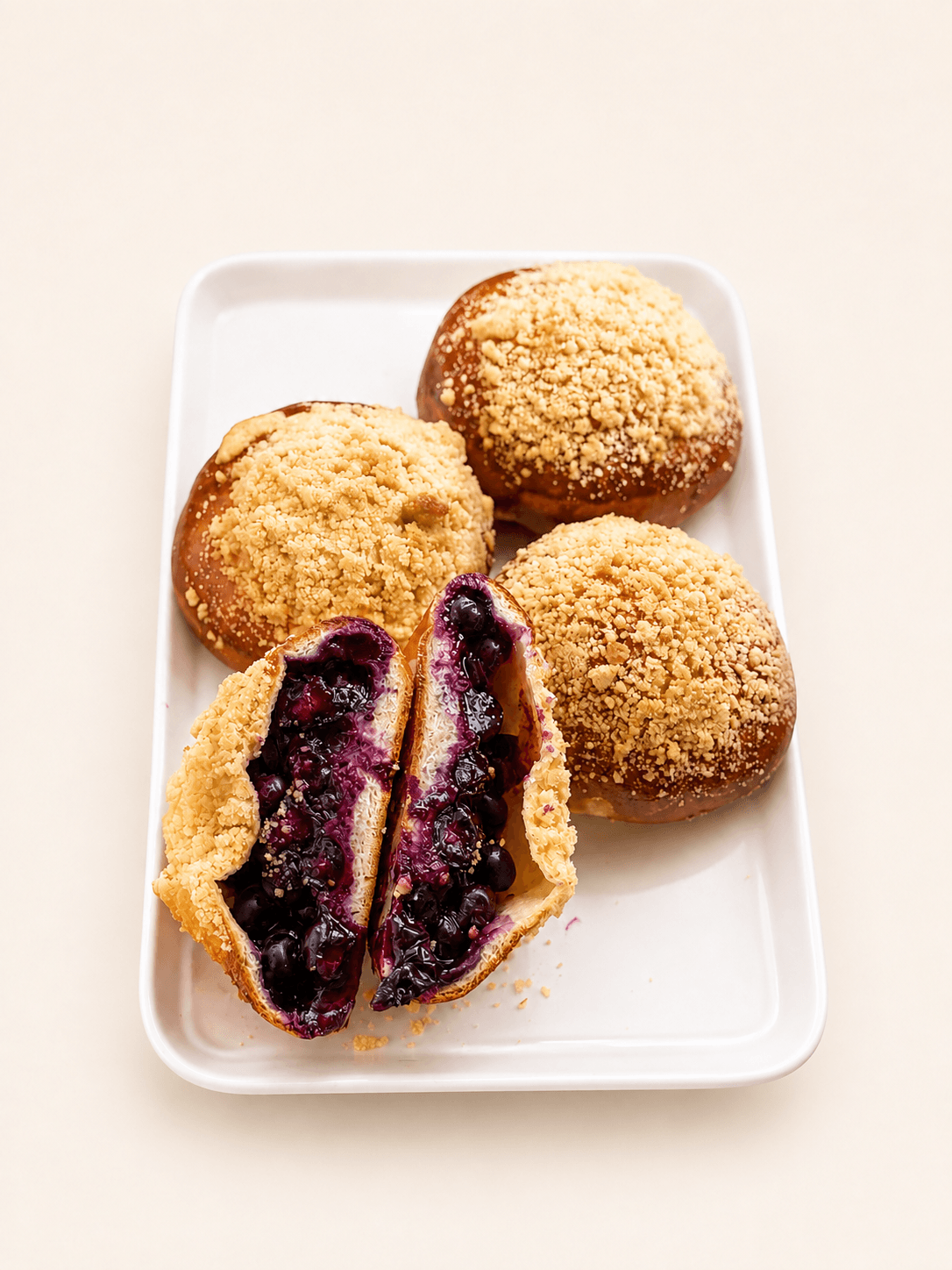
Every July, Polish food magazines publish rankings of the best jagodzianki, bakery by bakery, city by city. That happens because the bun is easy to make badly and the failures are all different. One is dry. One is filled with jam. One has a base like wet paper. The judging is not snobbery, it is the only way to tell them apart before you have paid.
If you want the full history of the bun, the forest bilberry it is built on and why the Polish season runs July to August, that is written out at What Are Jagodzianki? Polish Blueberry Buns, Explained. What follows is narrower: six things we look at, and what we think the right answer is on each. Some of these are matters of fact. Some are opinion, and are marked as such.
Fruit, and Whether It Is Fruit at All
This is the first test and it disqualifies most of the field. Cut a bun in half. If what runs out is a smooth, glossy, uniformly purple paste, it is jam, and it was cheaper and easier than fruit. Jam holds its shape in the oven, does not leak, costs less by weight and can be portioned with a piping bag. Every reason to use it is a reason of convenience.
A proper filling should show whole berries with their skins intact, sitting in a small amount of their own juice, slightly thickened with sugar and a little starch and nothing else. The berries should have collapsed a bit, not dissolved. You should be able to count them. Some purple should have bled into the crumb around the cavity, because that is what fruit does in a hot oven, and the stain is evidence rather than a flaw. A pale white crumb with a tidy dark disc in the middle usually means the filling never got hot enough to be part of the bun.
Quantity matters as much as quality. The filling should be the largest single component after the dough. A bun where the fruit is a teaspoon in the centre of a large bready mass is a bread roll with an incident in it. Our view is that if the fruit does not threaten to escape at some point during baking, there is not enough of it.
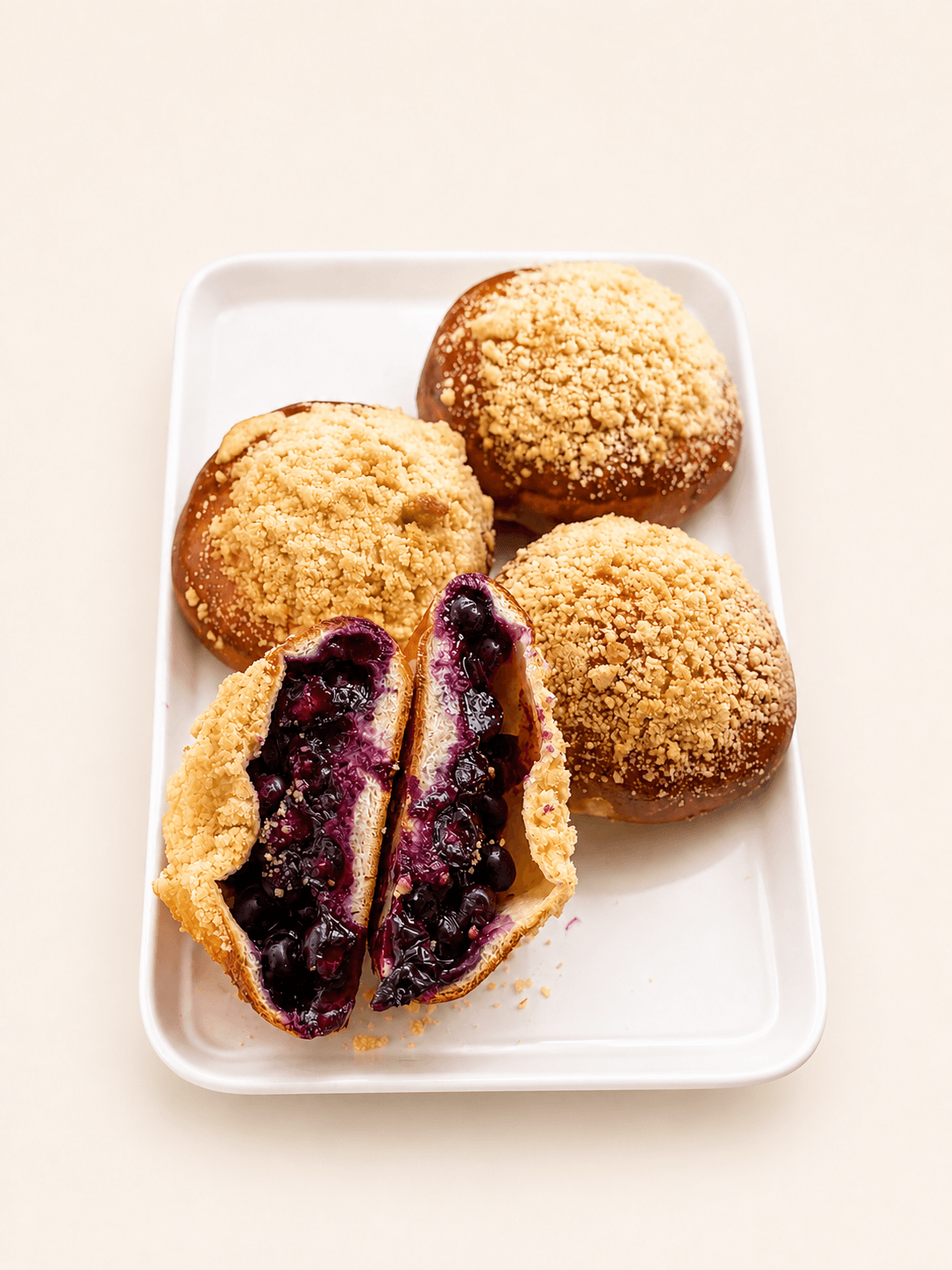 Blueberry Streusel Buns (Jagodzianki)Jagodzianki, Polish blueberry buns, four to a box. Soft enriched dough, blueberry filling, buttery streusel.£42Order this
Crumb: Pillowy Rather Than Bready
The dough is enriched: eggs, sugar, milk, butter, yeast. It is closer to brioche than to a sandwich loaf, and it should pull apart in soft strands rather than break into crumbs. Tear one open. Good dough stretches slightly before it gives. Bad dough snaps.
Bready jagodzianki usually come from two mistakes. The first is too little fat and sugar, which makes a cheaper dough that behaves more predictably in a busy kitchen. The second is rushing the proof. Enriched dough is slow because fat and sugar slow the yeast down, and there is no way around that except time. A bun that has been pushed through in an hour will look right and eat like a roll.
The test the day after is the honest one. Enriched dough properly made is still soft at breakfast the next morning. A bun that has gone stiff and dry overnight was underproofed or underenriched or both. This is also why we bake to the date ordered rather than in advance, and why the buns need 24 hours' notice: the dough sets the timetable, not the diary.
The Base, and the Soggy Bottom
The soggy base is the single most common fault in a fruit filled bun and the most avoidable. Hot fruit releases juice. Juice runs down. If it pools under the fruit and sits against the dough, the bottom of the bun turns to paste and the whole thing sags when you lift it.
There are ways to prevent it and all of them cost effort. Thicken the fruit properly before it goes in, so there is less free liquid to move. Seal the dough completely, with the seam on top and the base a single unbroken sheet, so juice cannot find a route out. Bake hot enough at the start that the base sets before the fruit gets going. Some bakers put a thin barrier of streusel or crumbs underneath the fruit to absorb what escapes, which works, though we prefer to fix the filling instead.
Judge it by picking the bun up. The base should be dry to the touch, matt rather than shiny, and firm enough to hold the weight of the fruit without flexing. A dark, damp, slightly translucent patch on the underside is a bun that leaked.
Streusel That Is Sandy, Not a Sheet of Sugar
The crumble topping, kruszonka in Polish, is flour, butter and sugar rubbed together. It should be loose and irregular, in pieces from the size of a grain of rice up to the size of a pea, and it should be sandy in the mouth: it breaks and disappears rather than sticking to your teeth. It ought to scatter a little when you bite.
The common failure is too much sugar or butter that was too warm when the crumble was made. The mixture melts and spreads in the oven and fuses into one hard, glassy, brittle lid. That lid tastes of sugar and nothing else, and it detaches from the bun in a single piece, which is the giveaway. The opposite failure is a dusting so thin it might as well be flour.
On proportion we hold a firm opinion. Streusel should cover the top generously enough that you cannot see much dough through it, and no more. It is seasoning and texture, not a second cake sitting on the first. Some bakeries pile it high because it photographs well. It eats badly.
Honest About Sourness
Bilberries, the wild berry a Polish jagodzianka is built on, are sharp. That sharpness is the point of the bun. The sweet dough and the buttery crumble exist to sit against fruit that pushes back. A bakery that loads the filling with sugar until nothing pushes back has removed the reason for the whole construction, and usually done it to disguise fruit that was tired or watery. Sugar is a good preservative and an excellent liar.
The test is what you taste last. After you swallow, there should be a trace of acidity left, something that makes you want the next bite. If the aftertaste is only sweetness, and if the sweetness of the filling, the dough and the streusel all read at the same pitch, the bun has no shape.
This is also the reason the traditional accompaniment across Poland is a glass of kefir or maślanka rather than tea or coffee. Sour dairy against sweet dough and sharp fruit is a complete idea, and it only works if the fruit has been left alone.
Here we have to be plain about our own buns. Ours are made with cultivated blueberries, which are larger, sweeter and milder than the forest bilberry a Polish jagodzianka is built on, and we say so rather than borrowing the name without qualification. Bilberries, Vaccinium myrtillus, are smaller, dark purple all the way through and considerably sharper. Anyone who grew up eating them in July will taste the difference immediately, and we would rather they hear it from us. What we can control is the amount of fruit, the balance of sugar and the treatment of the dough, and those are where we spend the effort.
Size, and What You Are Paying For
A jagodzianka in Poland is a substantial thing. It is sold as breakfast or as a meal in itself, not as a petit four, and the good ones need both hands and a plate. Small buns are a false economy for the baker as well as the buyer: the smaller the bun, the higher the ratio of crust to crumb and the less room there is for fruit, so the same recipe scaled down eats drier and less generously.
Our opinion is that anything much smaller than a closed fist stops working as a jagodzianka. Below that size the filling cavity cannot hold enough fruit to matter and the streusel starts to dominate. There is no upper limit that we have found, though past a certain point the base struggles to carry the weight.
Our Blueberry Streusel Buns come four to a box at £36, with 24 hours' notice, baked for the date chosen and delivered across London and Surrey. They contain eggs and milk, and are made in a kitchen that also handles sulphites, lupin and molluscs. Four is the box size because two people at a table will get through two each and still want a third, which is roughly the correct measure of a bun.
How to Use These Standards
If you are working out where to order blueberry buns in London, you can apply most of the six before you commit. Ask whether the filling is fruit or jam and listen for hesitation. Look at photographs of a bun cut open: whole berries, purple bleeding into the crumb, a streusel that looks loose rather than lacquered. Ask when it will be baked, because a bun baked to order and one that has sat on a shelf since morning are different products at the same price.
Then judge the one you get. Base dry, crumb soft the next day, fruit countable, a little acidity at the end. If four of the six are right, it is a good bun. If the fruit is jam, nothing else can save it.
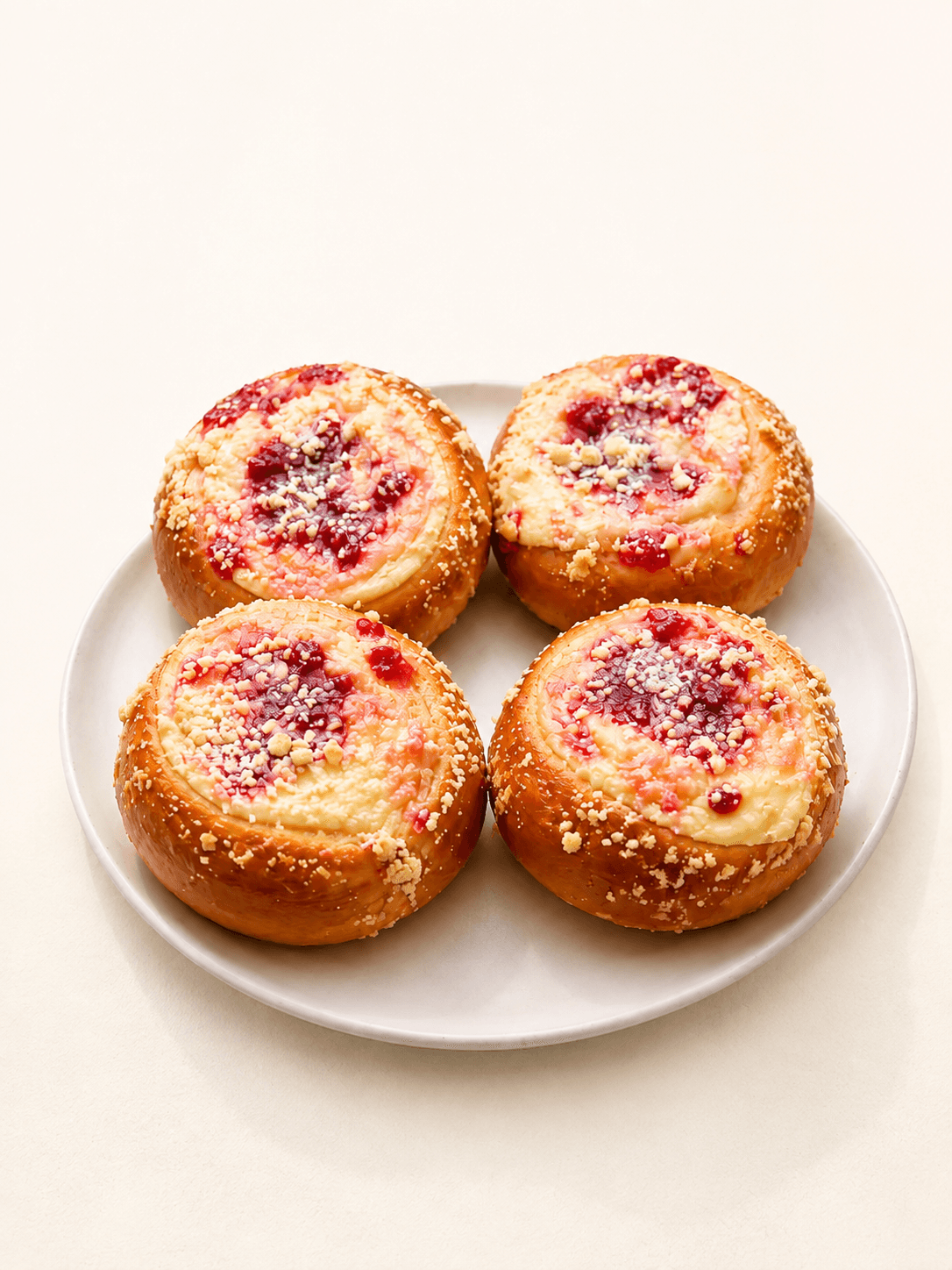
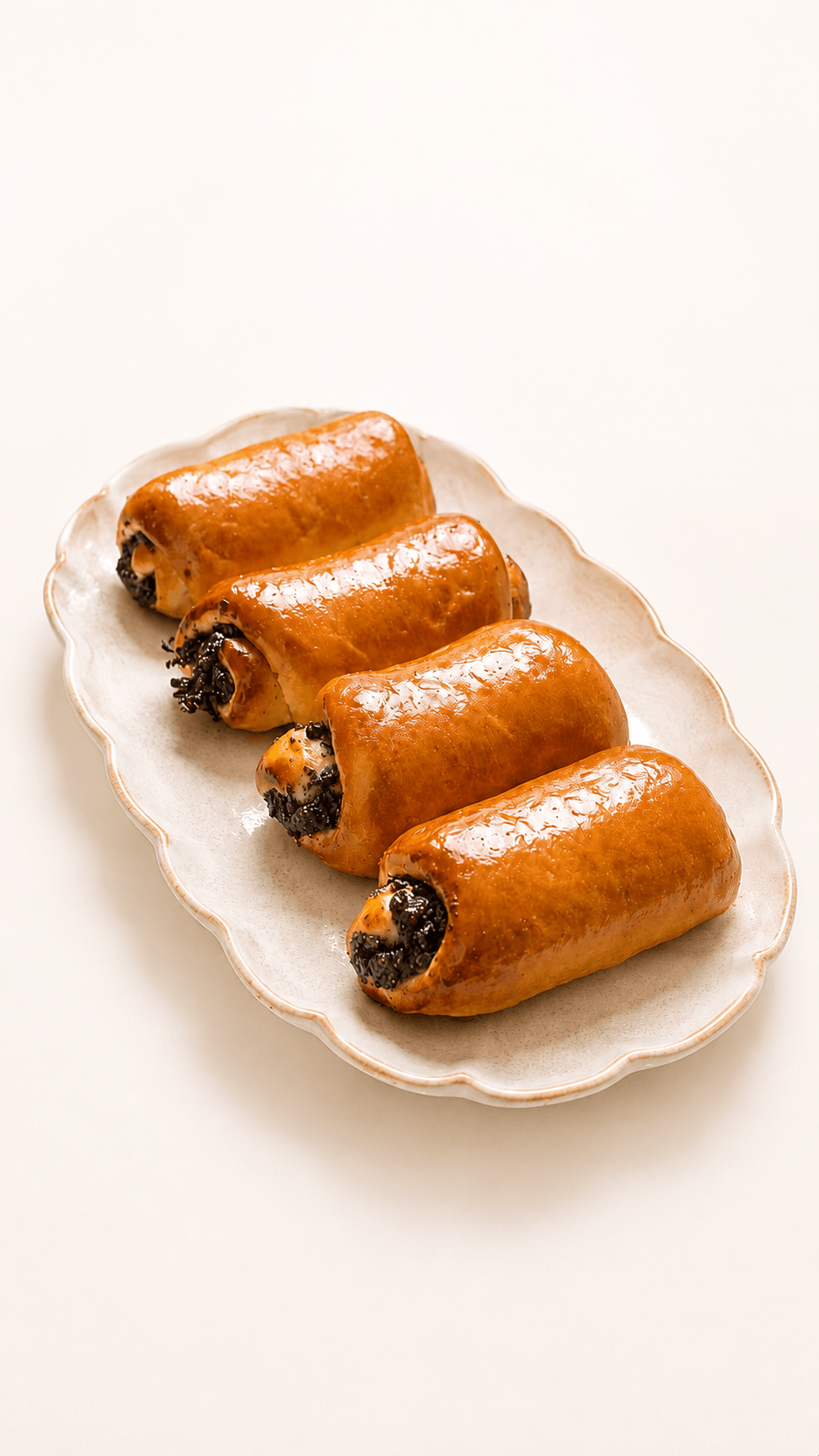
If blueberry season has passed or you fancy something else, the rest of what we bake is at the full collection, including strawberry vatrushki at £32 and poppy seed buns at £30, both with 48 hours' notice. For the buns themselves, order by the day before and tell us what time you want them, and we will bake to that.
Order it for the date you need
Everything here is baked to order for your date.
48 hours notice, 72 for bread. Delivered across London and Surrey.