
· 8 min read
How Jagodzianki Are Made: Dough, Filling and Streusel
Enriched dough that has to be slack, two slow proves, fruit that will leak if you let it, and a crumble that belongs on top rather than in it. How a Polish blueberry bun is actually built, and what can go wrong at each stage.
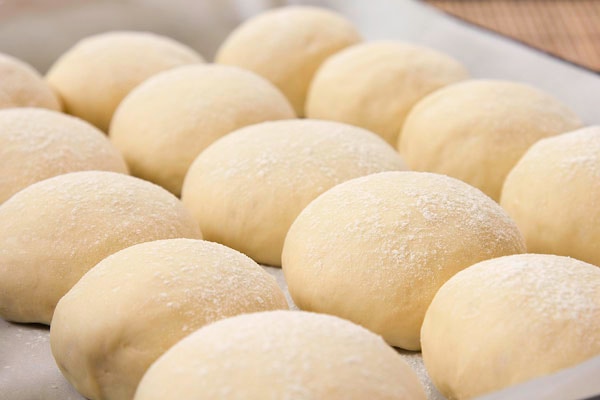
A jagodzianka is three separate pieces of work that have to finish at the same moment: a soft enriched dough, a fruit filling that holds its juice, and a rubble of butter, flour and sugar on top. Get one of them wrong and the whole bun tells on you. A dry crumb, a stingy smear of fruit, a wet grey base where the juice has run out and soaked the bottom. None of it is difficult. All of it is a matter of timing and patience, which is the same thing as saying it cannot be rushed.
This is how we build ours, and what a home baker should watch for at each stage.
The dough is enriched, which means it is slack and slow
An enriched dough carries fat, sugar and egg alongside flour, yeast, milk and salt. Every one of those additions makes life harder for the yeast. Sugar pulls water away from it. Fat coats the flour proteins and slows the gluten from linking up. Egg yolk brings more fat and lecithin. The result is a dough that rises more slowly than a lean bread dough and stays soft for days afterwards, which is exactly the point. A jagodzianka should still be tender the next morning.
The practical consequence is that the dough must be wetter than feels comfortable. A stiff enriched dough bakes into a bun with a tight, bready crumb, and that is the single most common fault in a home batch. Mix the flour, milk, egg, sugar, salt and yeast first and let them come together before the butter goes in. Softened butter, added in pieces once the gluten has some structure, works itself in without greasing the dough. Add it too early and you spend twenty minutes trying to persuade a slick, sliding mass to become a dough.
Knead longer than you think. An enriched dough is properly developed when a piece stretches thin enough to see light through it without tearing. In a mixer that is roughly ten to twelve minutes on a low speed. By hand it takes longer and it is worth doing, because the gluten network is what holds the bun round rather than letting it spread into a flat disc under the weight of the fruit.
Salt matters more than people expect in a sweet dough. Without enough of it the buns taste flat and cloying, and the sugar has nothing to push against.
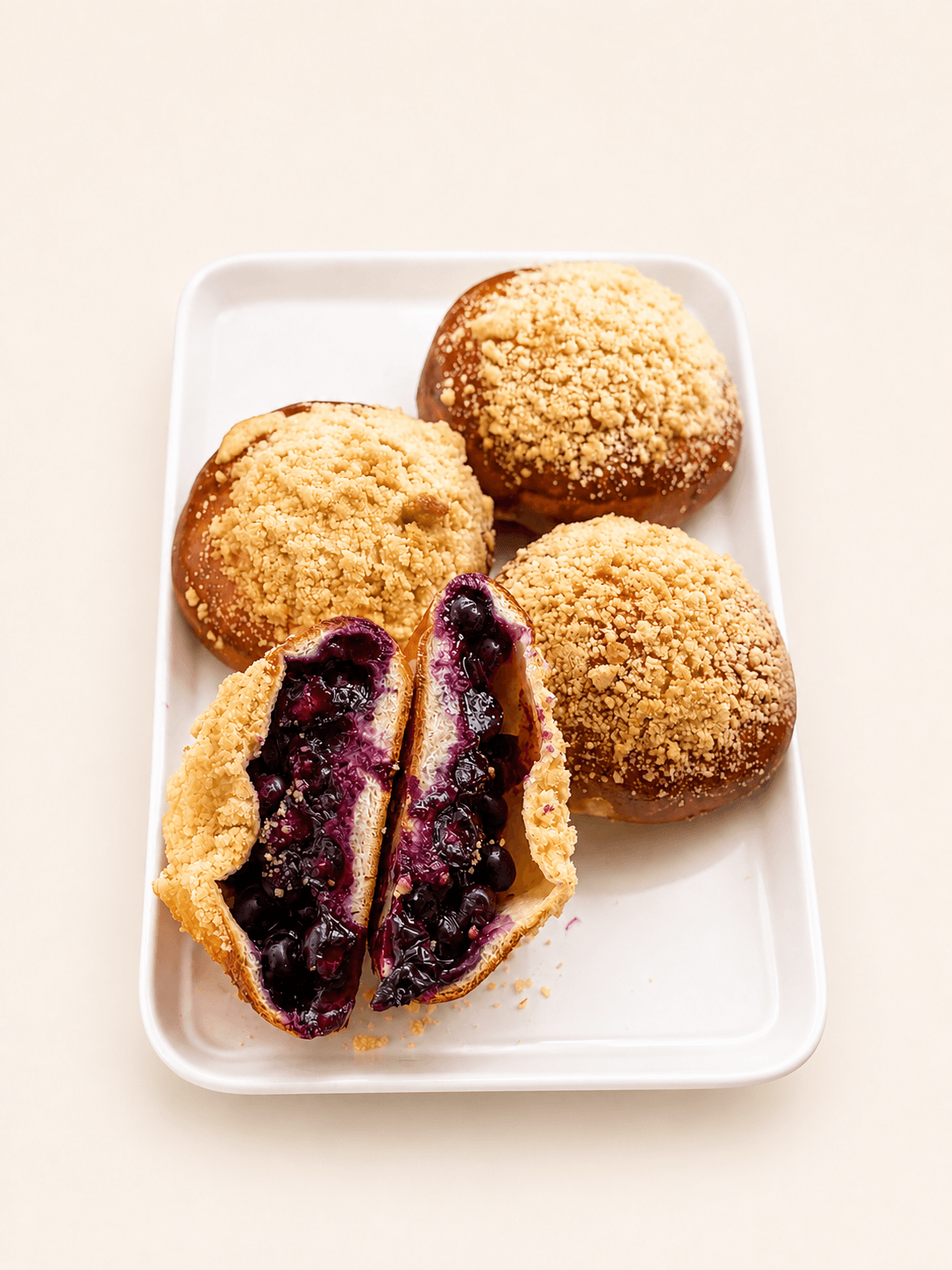 Blueberry Streusel Buns (Jagodzianki)Jagodzianki, Polish blueberry buns, four to a box. Soft enriched dough, blueberry filling, buttery streusel.£42Order this
Two proves, and what each of them is for
The first prove is about flavour and structure. The dough sits covered until roughly doubled, which at ordinary kitchen temperature means two hours or so, longer in a cold flat. Slower is better. An enriched dough pushed hard in a warm airing cupboard rises fast and tastes of nothing but yeast. Some of the best jagodzianki come out of a dough that went into the fridge overnight and was shaped cold the next morning. A cold dough is also far easier to fill, because it does not stick to everything and it holds a seam.
The second prove happens after shaping and filling, and it is the one people cut short. The shaped buns need to look visibly puffed and to feel airy under a fingertip, and the dent left by a light press should spring back slowly rather than snap back. Underproved buns burst at the seam in the oven and push their fruit out. Overproved buns collapse and go wrinkled on cooling. There is a window of maybe fifteen minutes where they are right, and knowing where that window is takes practice more than it takes a timer.
One detail that saves a lot of grief: seal the seam properly. Pull the dough up and pinch it hard, then set the bun seam side down on the tray. A pinched seam that has been merely folded over will open under steam pressure every time.
The filling, and why it leaks if the fruit goes in raw
Berries are mostly water. Bilberries, the small dark forest berry the Poles call czarna jagoda, hold a great deal of juice and release it the moment heat hits them. Put them into a bun raw and unthickened and the juice cooks out, pools at the base, and steams the crumb underneath into something wet and heavy. That is the soggy base, and it is a filling problem, not a baking problem. You cannot fix it with a hotter oven.
The answer is to bind the juice before it goes anywhere. A little cornflour or potato starch tossed through the fruit with the sugar sets the released juice into a soft gel as the bun bakes. Some bakers cook a portion of the fruit down into a thick base and fold the remaining berries through it whole, which gives both a set filling and berries that still burst. Both work. Semolina, breadcrumbs or a spoon of ground almonds scattered on the dough before the fruit goes on is the old insurance policy: it absorbs whatever escapes.
Do not be mean with the fruit. A jagodzianka with a teaspoon of jam in it is a disappointment that no amount of good dough will rescue. The filling should be enough that the bun looks slightly overloaded when you close it, and the purple should have bled into the crumb around it by the time it is cut. That stain is the fruit, and it is the mark of the real thing. Wild bilberries are purple all the way through, unlike the cultivated highbush blueberry, which is green inside and much milder in flavour. The botanical detail is worth reading if you want to know why the two behave so differently in the oven.
Sugar in the filling should be restrained. The dough is already sweet and the crumble on top is sweeter still. The fruit is there to be sharp.
Kruszonka: flour, butter, sugar, rubbed to a rubble
The streusel topping, kruszonka in Polish, is the simplest part and the part most often ruined. Cold butter, plain flour and sugar rubbed together with the fingertips until it forms uneven lumps, some the size of a pea, some smaller. Stop before it becomes a paste. If the butter warms and the mixture turns smooth, chill it and break it up again, or it will melt into a flat glaze rather than staying as crumbs.
It goes on top rather than through the dough for a plain reason: it needs dry heat to set. Buried in a bun, streusel simply dissolves into the crumb and adds nothing but fat. On the surface it toasts, the sugar caramelises at the edges, and it gives the contrast that makes the whole thing work, a crisp buttery layer over soft dough and wet fruit. Brush the shaped buns with egg wash and press the crumble on gently so it sticks. Anything loose falls off on the tray and burns.
A scatter of crumble is not enough. It wants a proper layer, thick enough that you eat some of it in every bite.
Where they go wrong, honestly
Four faults account for nearly all bad jagodzianki.
- A dry bun, from too little fat, too much flour on the bench, or a dough baked too long. Enriched dough colours quickly because of the sugar and egg, so it looks done before it is, and then people leave it in longer to be safe.
- A mean filling, which is usually cost cutting or nerves about leakage.
- A soggy base, from unthickened fruit or from stacking hot buns before the steam has escaped.
- A dull, bready crumb, from a dough that was too stiff or proved too fast in too warm a spot.
Cooling matters as much as baking. Move the buns onto a rack straight out of the oven. Left on the hot tray they steam themselves from underneath.

What our 24 hours is actually for
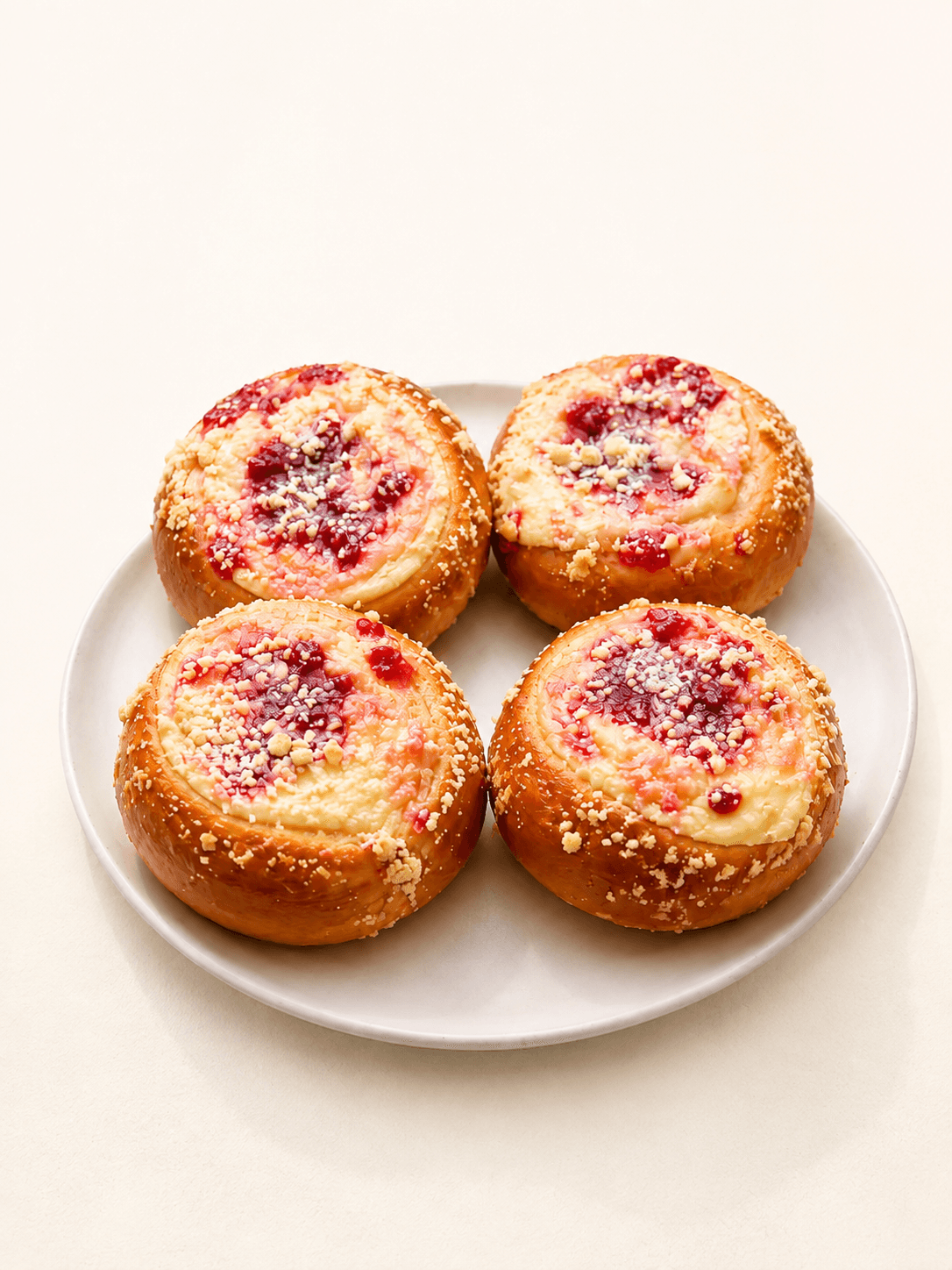
The Blueberry Streusel Buns are £36 for a box of four and need 24 hours' notice. That is not an administrative buffer. The dough is mixed and given a long, cold first prove, shaped and filled the next morning, proved a second time, topped and baked so the box goes out while the crumble is still crisp. Nothing sits on a shelf here, because there is no shelf. They are soft, fluffy enriched buns filled with juicy blueberries under a buttery golden streusel crust, made with eggs, sugar, salt, yeast, flour and milk. They contain eggs and milk, and the kitchen also handles sulphites, lupin and molluscs. In Russian they are булочки с черникой и штрейзелем.
If you are baking at home and want a benchmark, order a box and cut one in half while it is still slightly warm. Look at how far the purple has travelled into the crumb and how thick the fruit layer is against the depth of dough. That ratio is the thing to copy.
The rest of the buns and babka run on the same dough principles, and most of them need 48 hours rather than 24. If you are in Surrey, the buns can travel alongside the Wednesday bread round that goes out to Virginia Water, Weybridge, Ascot, Sunningdale, Sunninghill, Egham and Englefield Green the same afternoon.
Eat them the day they arrive, with a glass of kefir or maślanka if you have it. Anything left the next day is improved by ten minutes in a low oven, which crisps the kruszonka again and softens the crumb.
Order it for the date you need
Everything here is baked to order for your date.
48 hours notice, 72 for bread. Delivered across London and Surrey.