
· 8 min read
Kruszonka: the Streusel Topping That Makes the Bun
Kruszonka is four ingredients rubbed together in under two minutes, and it decides whether a fruit bun holds up or goes soggy. Here is the ratio, the two ways it fails, and what a crumble lid does that a glaze cannot.
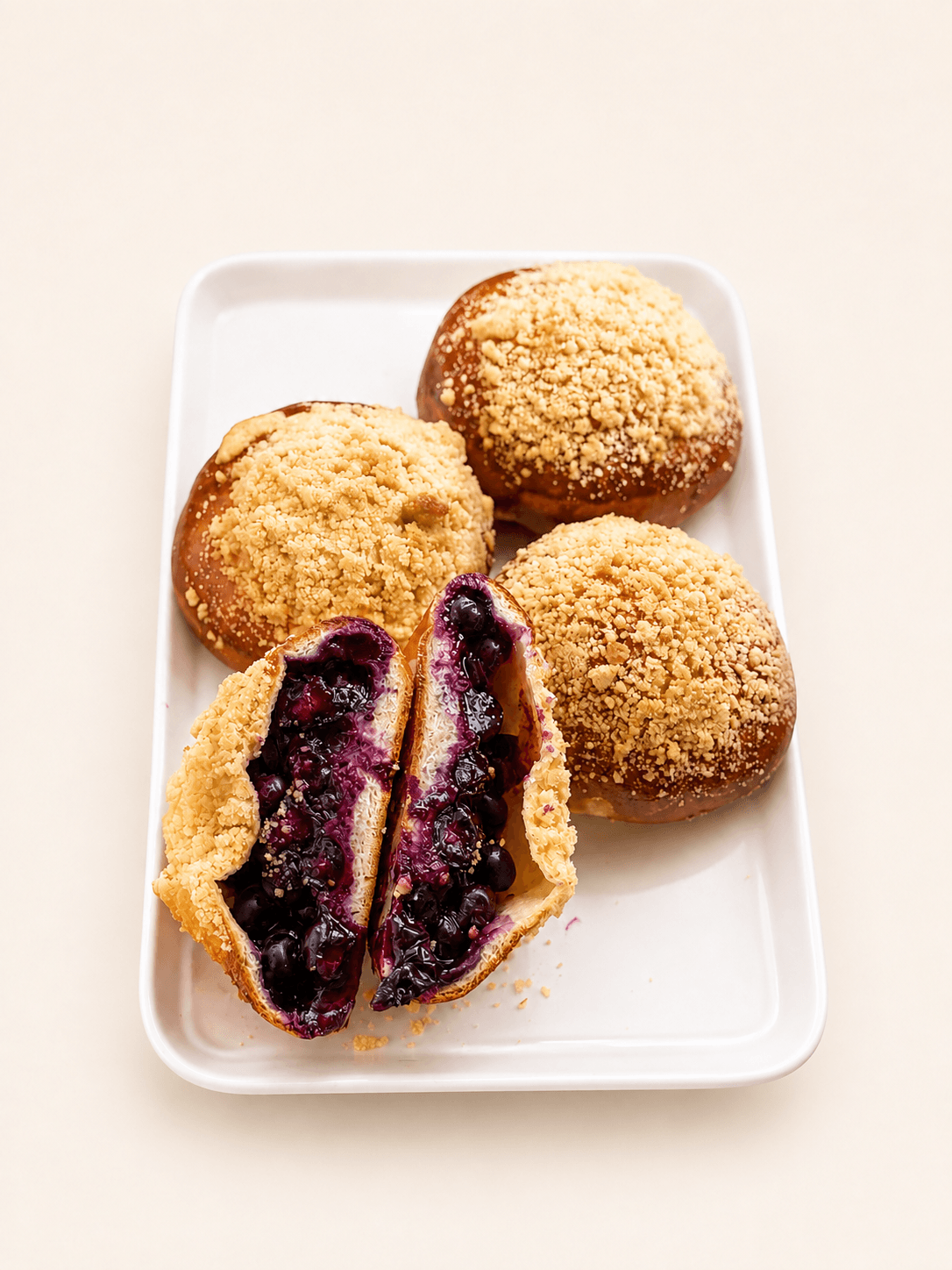
Kruszonka is the crumble that sits on top of a Polish sweet bun: flour, butter and sugar rubbed together into loose lumps and scattered over the proved dough before it goes into the oven. Four ingredients if you count the pinch of salt. Two minutes of work. It is the shortest part of the recipe and the part that decides whether the bun is any good.
The bun underneath, the wild bilberry it is traditionally built on, and the July and August season in Poland are all set out in what jagodzianki actually are. This piece is about the lid.
The ratio, and what happens when you move it
The working ratio is two parts flour to one part butter to one part sugar, by weight. In practice that means 200 g plain flour, 100 g cold butter and 100 g caster sugar, which is enough to top a dozen buns generously at 20 to 25 g each. Anyone who has made a British apple crumble will recognise the numbers, because they are close to the same.
Move the ratio and the topping changes in ways you can predict.
- More butter, say 200 g flour to 130 g butter, gives bigger clumps and a richer, shorter crumb. It also spreads. Past a certain point the crumbs join up in the oven and you get a sheet rather than crumbs.
- More flour, 300 g to 100 g butter, gives a dry, pale, sandy topping. It stays separate and it stays powdery, and it tastes of raw flour if the bun comes out of the oven a minute early.
- More sugar gives crackle and colour, because sugar caramelises where flour only toasts. Too much and the topping turns to toffee, welds to the tray and sets hard enough to be unpleasant against the soft crumb underneath.
Caster sugar and icing sugar behave differently and it is worth choosing on purpose. Caster keeps a little grit and gives the topping its crunch. Icing sugar dissolves into the butter almost immediately, which makes a finer, more uniform crumble that browns faster and burns sooner. My preference is caster, coarse crumbs, and a pinch of fine salt, about 1 g per 200 g of flour, because sweet crumble with no salt in it tastes flat next to sharp fruit.
A spoonful of ground almonds in place of some of the flour makes the topping shorter and nuttier. Semolina or fine polenta in place of 20 g of the flour makes it grittier and better at absorbing juice. Neither is traditional. Both work. Oats, which the British throw into crumble without thinking, are wrong on a yeasted bun: they soften unevenly and they read as breakfast rather than pastry.
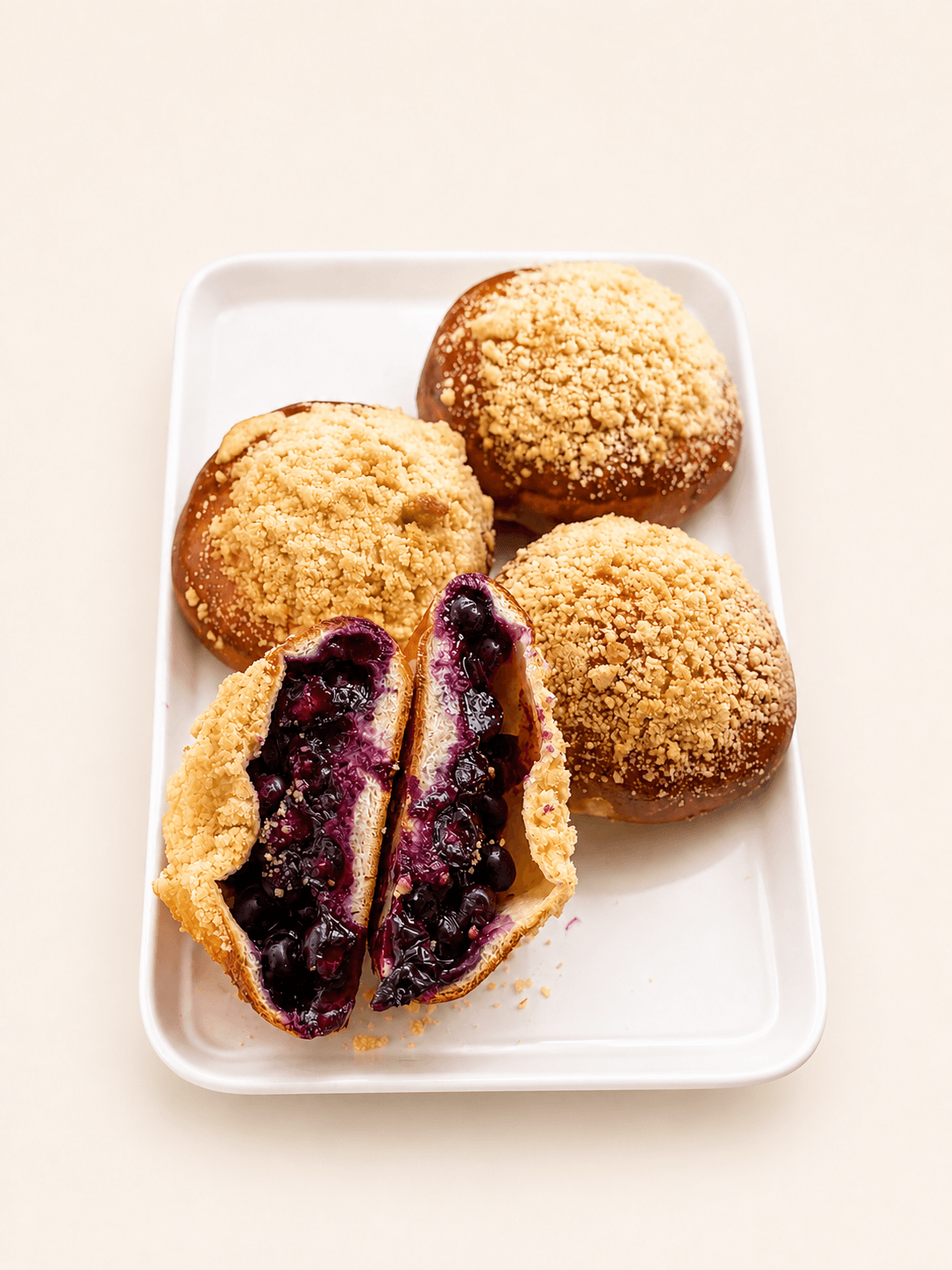 Blueberry Streusel Buns (Jagodzianki)Jagodzianki, Polish blueberry buns, four to a box. Soft enriched dough, blueberry filling, buttery streusel.£42Order this
Cold butter, a light hand, and the two ways it fails
Butter straight from the fridge, at around 4C, cut into cubes of roughly 1 cm. Flour and sugar in the bowl first, butter in last, and then fingertips only. Palms run at skin temperature, about 34C, and butter starts to soften at 15C. Rubbing with the flats of the hands melts the fat into the flour before the crumbs have formed.
Stop early. The mixture should be a mix of sizes, from coarse breadcrumb to hazelnut, with a few pieces of butter still visible. Squeezing a handful into a lump and then breaking it apart again gives that variety in one movement, and variety is what you want: the small pieces knit into a base, the big ones stand up and go golden.
There are exactly two ways this goes wrong, and both are about temperature.
Overworked, the butter smears and coats every particle of flour. There is nothing left to hold a shape. It bakes into a flat, fine, sandy layer that tastes of butter and sugar but has no crunch at all, or worse, into something closer to a thin shortbread biscuit sitting on top of the bun. It looks acceptable and eats like a lid of pastry.
Too soft, the butter melts before the flour has set. The crumbs collapse, run down the sides of the bun and pool on the tray, leaving a shiny sheet welded to the top and a caramel puddle underneath. On a fruit bun this is the more common failure, because kitchens in July are warm.
The fix for both is the freezer. Twenty minutes with the finished crumble spread on a tray, and it goes onto the dough cold and stays in pieces long enough for the flour to cook. In a warm kitchen, mix it first, freeze it, and prove the buns while it chills.
Scatter it, do not press it. Pressing pushes the crumbs into the dough, where they wet through and disappear. A light brush of egg wash on the dough gives the crumble something to hold onto, and anything that falls off in the oven was never going to stay on.
Streusel, crumble, posypka: the same idea in four languages
Kruszonka comes from kruszyć, to crumble. The German streusel comes from streuen, to scatter, and on a proper Streuselkuchen the topping can be as deep as the cake itself, in clumps the size of marbles. Russian bakers use the borrowed word штрейзель, and in parts of Poland and Ukraine the same thing is called posypka, from the verb for sprinkling. British crumble is the outlier: it goes straight onto fruit in a dish, with no dough underneath, often with oats and always with more juice.
The differences follow from what the topping has to do. British crumble sits in liquid, so it is made looser and wetter and is expected to go partly soft. German streusel sits on cake, which is dry, so it can be rich and thick without going anywhere. Kruszonka on a fruit bun has the hardest job of the three: it has to stay crisp on a surface that is producing steam from below and juice from the inside.
What a crumble lid does that a glaze cannot
A sugar glaze is the obvious alternative and it is what goes on a plyushka or a doughnut. On a fruit bun it fails on both counts.
First, texture. Blueberries release their juice from around 80C, and a bun full of fruit is a bun full of moisture. Glaze adds sweetness and shine and nothing else. Against wet fruit and soft dough, every part of the mouthful is soft. Kruszonka is the only dry, crisp element in the whole thing, and it is what stops the bun being one texture from start to finish. Roughly a fifth of each bite should be crumble. Less than that and you stop noticing it.
Second, structure. The crumble is a lid. It caps the seam where the dough was pinched closed, it soaks up the juice that comes up through the top instead of letting it run down the sides, and it toasts in that juice, which is why the underside of a good crumble is stained purple and tastes of fruit rather than flour. The butter in it also bastes the crust as it melts, so the top of the bun stays soft where a bare crust would dry.
A glaze would simply dissolve. Steam turns fondant tacky within an hour and syrup slides off a domed bun onto the paper. On the second day the difference is clearer still: glaze is sticky and dull, while crumble comes back with four or five minutes in a warm oven.
How ours are made and how to order them
Our blueberry streusel buns are four to a box at £36, made with soft enriched dough, a juicy blueberry filling and a buttery golden crumble baked on top. They are made with eggs, sugar, salt, yeast, flour and milk, they contain eggs and milk, and the kitchen also handles sulphites, lupin and molluscs. They need 24 hours' notice and they are baked for the date you choose, so nothing sits on a shelf waiting.
We call them jagodzianki because that is the name customers search for, and we say plainly what is different: ours are made with cultivated blueberries, which are larger, sweeter and milder than the wild forest bilberry a Polish jagodzianka is built on. The dough and the kruszonka follow the tradition. The berry is not the same berry, and we would rather say so than borrow the name quietly.
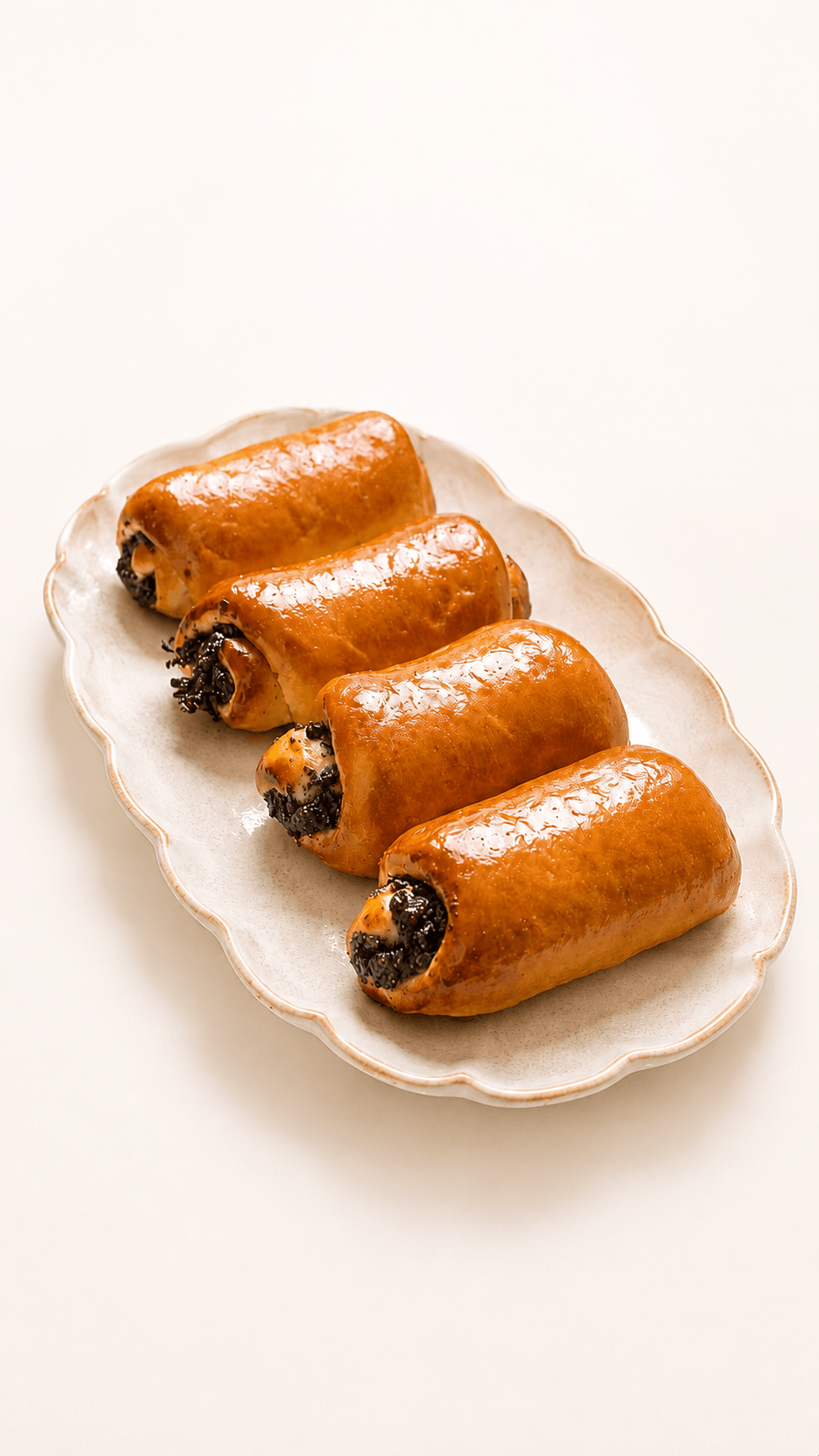
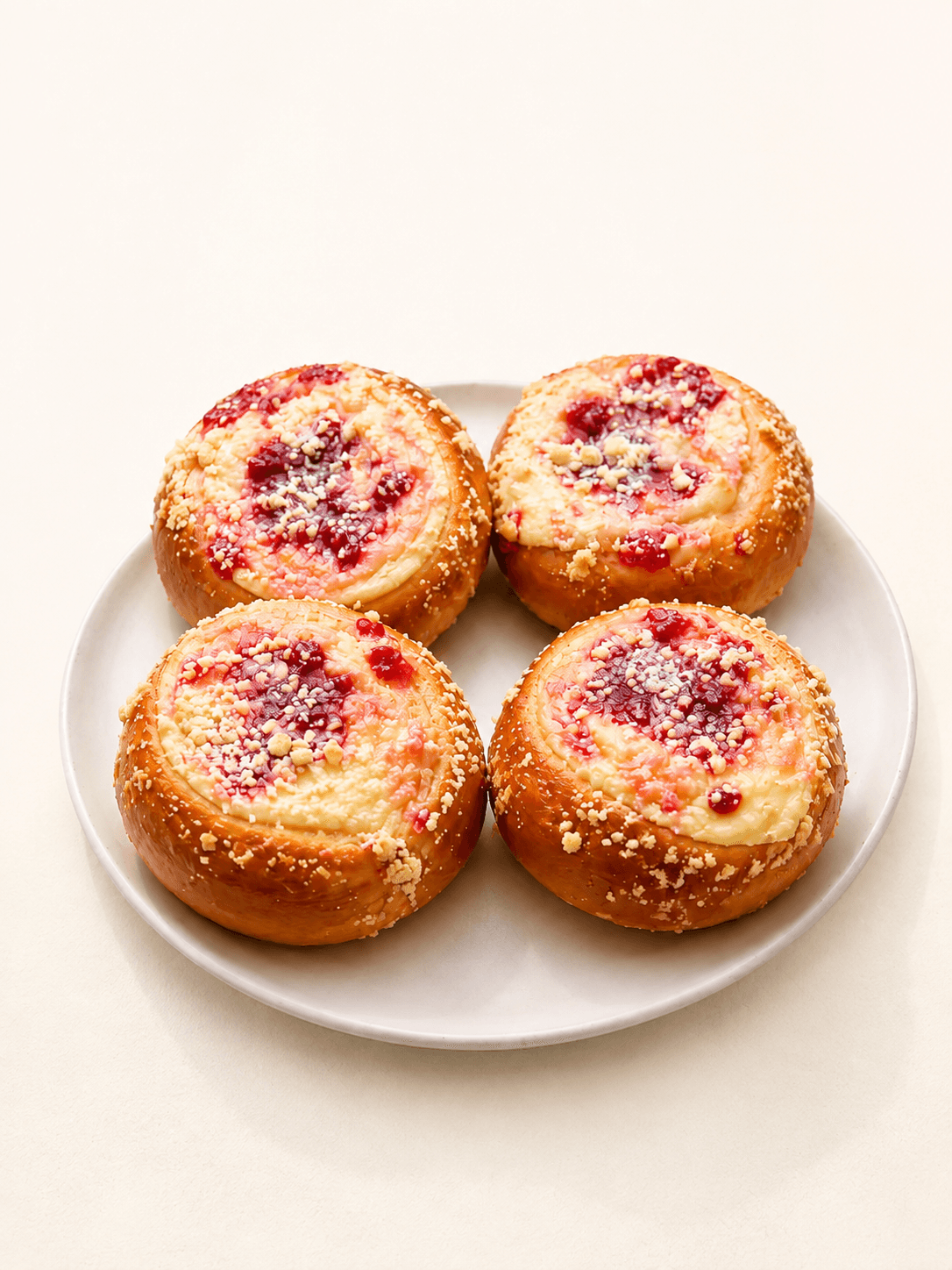
If you want to compare toppings, the rest of the buns and babka section has the alternatives: the Moscow plyushka at £32 is glazed rather than crumbed, the poppy seed buns are £30 for four, and the strawberry vatrushki at £32 are open topped with tvorog in the middle. Ordering two of them alongside the blueberry buns is the quickest way to see why the crumble matters.
The kitchen is in Belgravia, by appointment, Monday to Saturday, with delivery across London and Surrey. Twenty four hours is all the notice we need for buns: email info@mikebakes.uk or call +44 7922 122149 with the date you want them, and they will be scattered, baked and boxed that morning.
Order it for the date you need
Everything here is baked to order for your date.
48 hours notice, 72 for bread. Delivered across London and Surrey.