
· 7 min read
Blueberry Pastries in London: a Guide to What Is Worth Ordering
Blueberries behave differently in every kind of pastry: a yeasted bun soaks up the juice, laminated dough resists it, a tart sets it and a muffin waters it down. Here is what that means for what is worth buying in London.
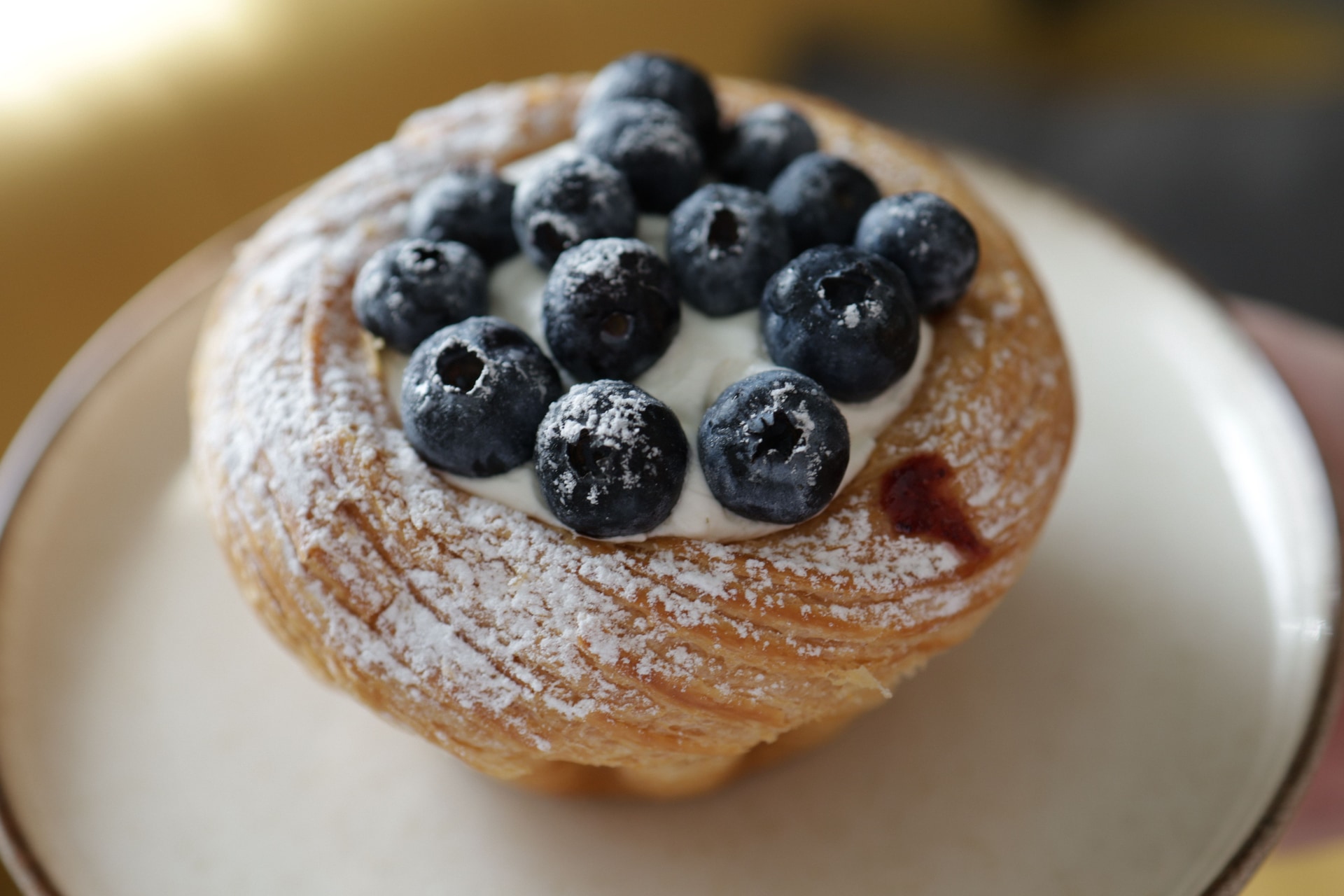
A blueberry is roughly 85 per cent water. That single number decides almost everything about how it behaves in a pastry. Heat the berry and the skin splits, the juice runs, and whatever is around it either absorbs the liquid, sets it, or goes soggy. Most of the difference between a good blueberry pastry and a disappointing one is not the quality of the fruit. It is whether the baker chose a structure that can cope with the juice.
That is the useful way to shop for blueberry pastries in London. Not by the picture, which always looks the same, but by asking what the dough or pastry underneath is going to do when the fruit lets go.
Yeasted dough drinks the juice
An enriched yeast dough is the most forgiving home for berries. The crumb is open, elastic and full of egg and milk, so when the fruit bursts in the oven, the liquid goes into the bread rather than pooling at the bottom. The purple staining you see through the crumb of a good blueberry bun is not decoration or colouring. It is the juice travelling outward into the dough, and it is the sign that real fruit went in.
This is why the Polish jagodzianka works so well, and why bakers across Eastern Europe reach for a soft yeasted bun when berries are in season rather than a pastry case. The dough is built to be wet. It handles fruit the same way it handles a heavy cinnamon filling or a curd filling, which is to say by soaking up what it is given and staying soft for a day afterwards.
A crumble topping helps twice over. Butter, sugar and flour rubbed together and scattered on top of the bun form a lid: a dry, crisp layer that draws off steam and stops the surface going tacky. Poles call it kruszonka. In German and Austrian baking, and in ours, it is streusel. Without it, a fruit filled bun tends to weep at the seam.
Our Blueberry Streusel Buns are exactly this construction: an enriched dough of eggs, sugar, salt, yeast, flour and milk, wrapped around blueberries, with a buttery crumb baked on top. Four to a box, £36, 24 hours' notice, baked for the day you ask for and delivered across London and Surrey.
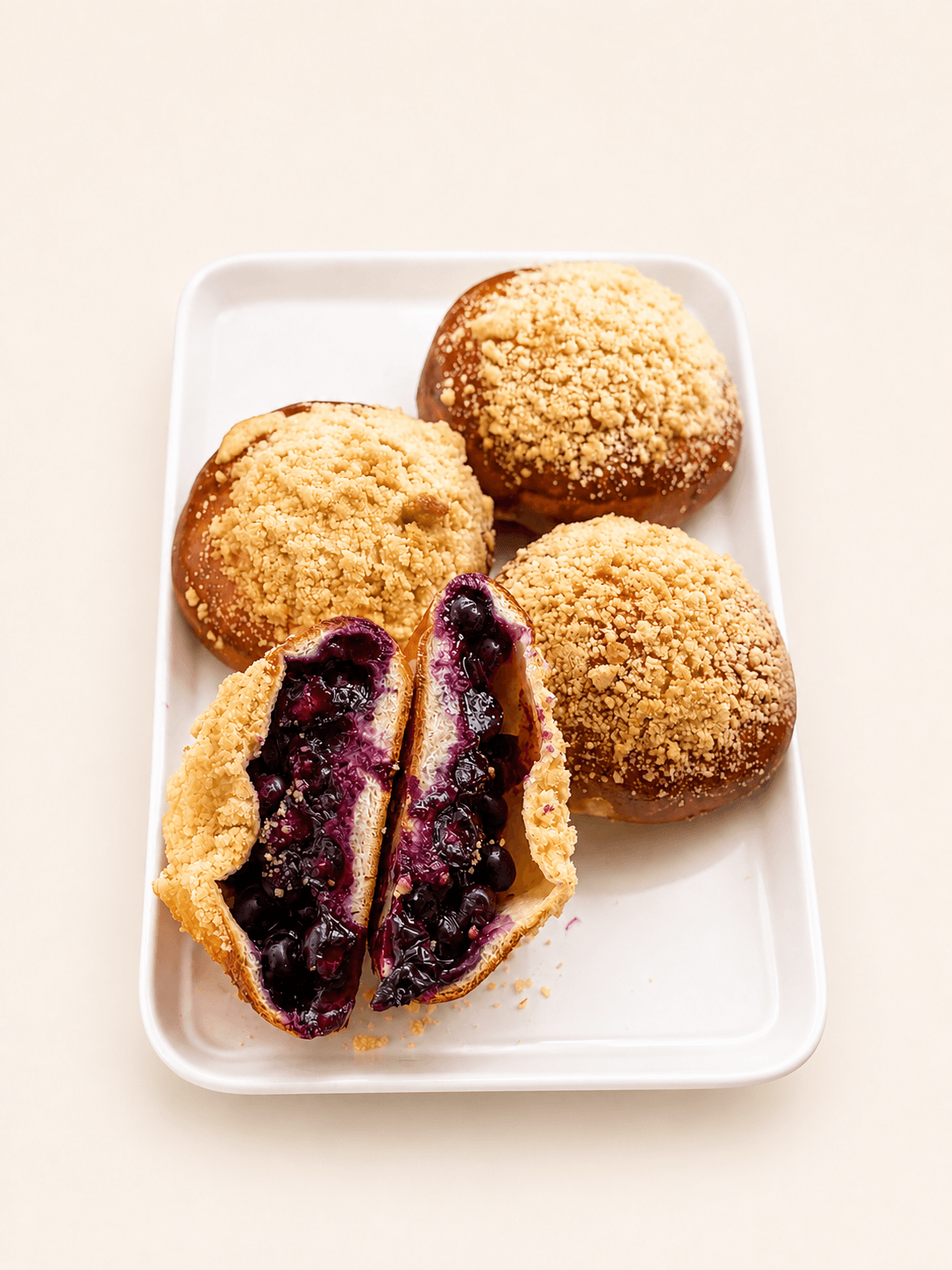 Blueberry Streusel Buns (Jagodzianki)Jagodzianki, Polish blueberry buns, four to a box. Soft enriched dough, blueberry filling, buttery streusel.£42Order this
Laminated pastry fights the fruit, and often loses
A croissant or danish is the opposite proposition. Lamination is dozens of alternating layers of butter and dough. The whole point is that the butter turns to steam in the oven and pushes the layers apart while they crisp. Introduce a berry with a broken skin into that structure and you are putting water where you wanted air. The layers under the fruit stop separating properly and go dense and pale.
That is why almost every blueberry danish you will find in London does the same three things: it uses pastry cream as a barrier between fruit and pastry, it keeps the fruit count low, and it often adds the berries after baking, glazed with something shiny to hold them in place. Sometimes that is done well. A crisp pastry base, proper vanilla custard and five or six good berries on top is an honest thing to eat, and nobody is pretending the fruit went through the oven.
What is less honest is the version where a spoon of purple gel does the work. Look at the cut face. If the colour stops at a sharp line and the pastry underneath is uniformly beige, that is compote or fruit filling from a bucket, not fruit. It will taste sweet and slightly floral and nothing like a berry.
Tarts set it, muffins dilute it
A tart is the neatest solution to the juice problem, because a tart sets the fruit in something. Either the berries are baked into a frangipane or a custard that holds the liquid as it cooks, or they are placed raw on a set cream in a blind baked shell and never heated at all. Both work. Both keep the pastry crisp, which is the whole test of a tart.
The cost is that a tart is a project. Pastry, filling, blind baking, cooling, assembly, and it wants eating on the day. Our tarts run to that logic, and you can see the whole section under tarts. The Tart Strawberry at £51 is the clearest example of fruit on set cream in a crisp shell, and the Lemon Tartlets with Meringue at £30 for six show the same base doing a different job.
A muffin is the weakest carrier of the four, and it is the most commonly sold. Muffin batter is loose, sweet and heavily leavened, so the berries sink, the crumb around them goes gummy, and the sugar in the cake overwhelms whatever tartness the fruit had. A blueberry muffin can be very good, but it is a cake with fruit in it rather than a fruit pastry. Judge it as a cake. If it costs the same as a bun with a handful of berries in it, you are buying more sugar and less fruit.
Fruit or fruit flavour: how to tell in London
A short list of things worth checking before you spend money on blueberry desserts in London.
- Count the berries in the photograph, then halve it. Berry buns and berry pastries are photographed at their most generous.
- Ask whether the fruit is baked in or added after. Both are legitimate, but the answers taste different, and only one stains the crumb.
- Be suspicious of a perfectly even purple. Real fruit bleeds unevenly.
- Freeze dried powder and blueberry flavoured icing are common on supermarket pastries. They give colour and a sweet, slightly artificial note, and no acidity at all.
Acidity is the thing to hold out for. The berry that made the jagodzianka famous is not the cultivated highbush blueberry from a punnet. It is czarna jagoda, the bilberry, Vaccinium myrtillus, smaller, darker, purple all the way through instead of green inside, and considerably sharper. The same berry grows wild on British moorland: bilberry in England, whinberry in Wales, blaeberry in Scotland, ripe in July and August. It never became a commercial crop here because the bushes sit low to the ground and picking is slow work. That scarcity is why so few blueberry pastries taste tart.
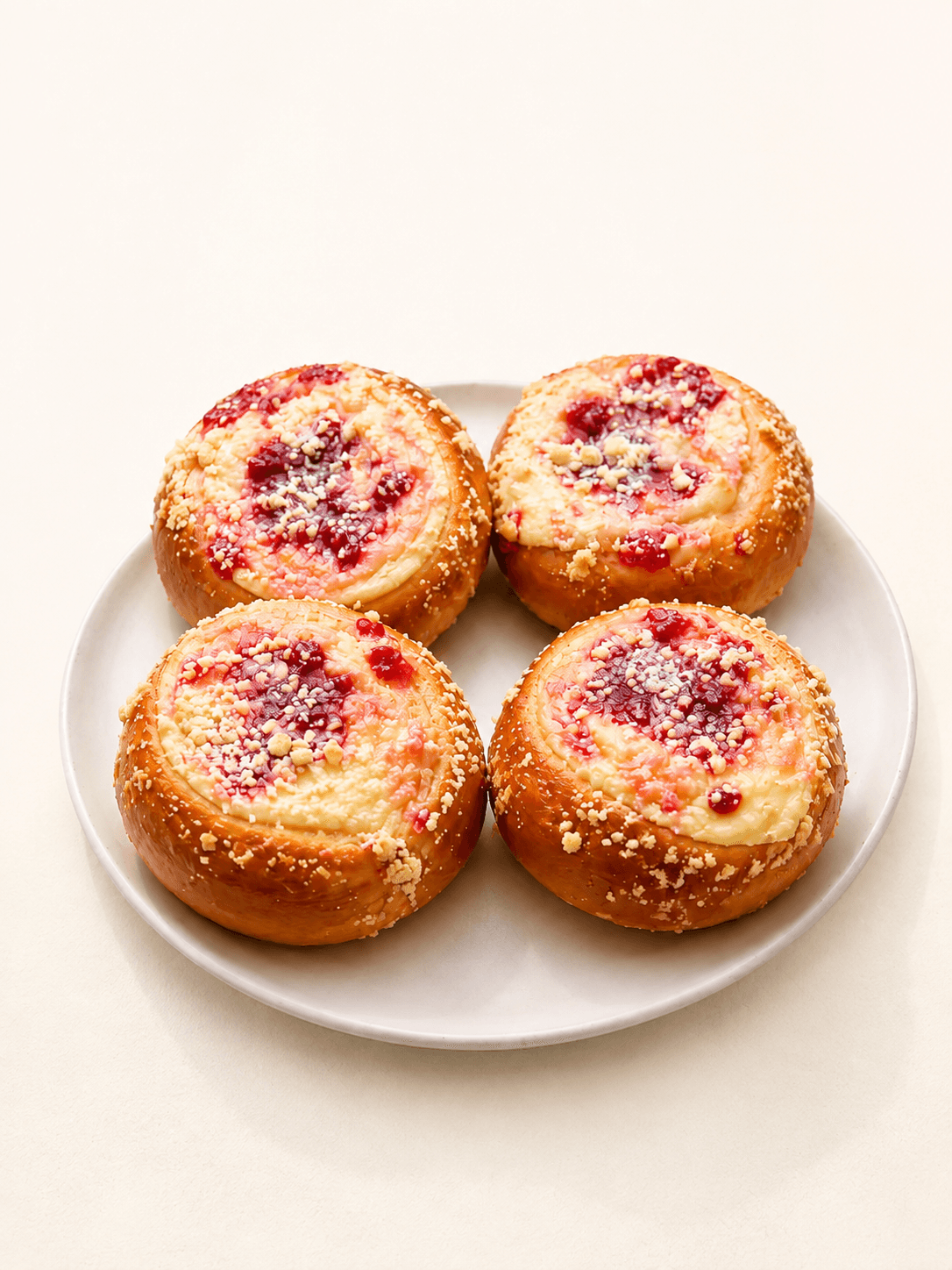

What we make with fruit, and what to order alongside
We are a small kitchen in Belgravia and everything is baked to order for the date chosen, so nothing sits under a light going soft. That matters more with fruit than with anything else. A blueberry bun is at its best within a few hours of coming out of the oven, good the next morning, and tired by the second day.
If you want fruit beyond the buns, the Pavlova Cake at £72 carries fresh berries on cream over a crisp meringue shell, which is the raw fruit approach at cake scale. The Meringue Roll at £45 puts berries and cream inside a chocolate sponge. Bird's Milk Cake at £78 sets berries against dark Belgian chocolate and soufflé. Strawberries and Cream Cake is £65. For cooked fruit, the Apple Pie at 20 cm is £40, and the Gluten Free Peach Pie at 20 cm is £46. The full list sits on our cakes page.
Two practical notes. Cakes need 48 hours' notice and the buns need 24, so a Saturday morning box means ordering by Friday morning. And if you are eating them the Polish way, have a glass of kefir or maślanka next to them: the sourness cuts the butter in the streusel better than tea does.
Four buns feed two people generously or four people politely. For a table of six with anything else on it, order two boxes and put them out warm from the oven at 150C for five minutes, no longer, or the crumble goes hard.
Email info@mikebakes.uk or call +44 7922 122149 with a date and a postcode.
Order it for the date you need
Everything here is baked to order for your date.
48 hours notice, 72 for bread. Delivered across London and Surrey.