
· 6 min read
Jagodzianki, Vatrushki and Plyushki: Sweet Buns Compared
One enriched dough, three answers: closed around fruit, open around curd, or folded and sugared with nothing inside. What each bun is for, when it is eaten, and which one survives a lunchbox.
Start with the dough, because all three begin in the same bowl. Eggs, sugar, salt, yeast, flour and milk, worked until it is soft enough to take a thumbprint and hold it. Butter goes in after the gluten has developed. This is the enriched yeast dough that runs from Warsaw to Vladivostok, and the arguments between countries are not really about the dough at all. They are about what you do with it once it is proved.
Three answers, all of them old, all of them still eaten weekly by people who grew up with them. The Polish bun is closed around fruit and crumbed on top. The Russian vatrushka is left open with a pool of sweetened curd in the middle. The plyushka is folded, sugared and holds nothing whatsoever. Once you see them side by side, the differences stop being cosmetic.
One dough, three shapes
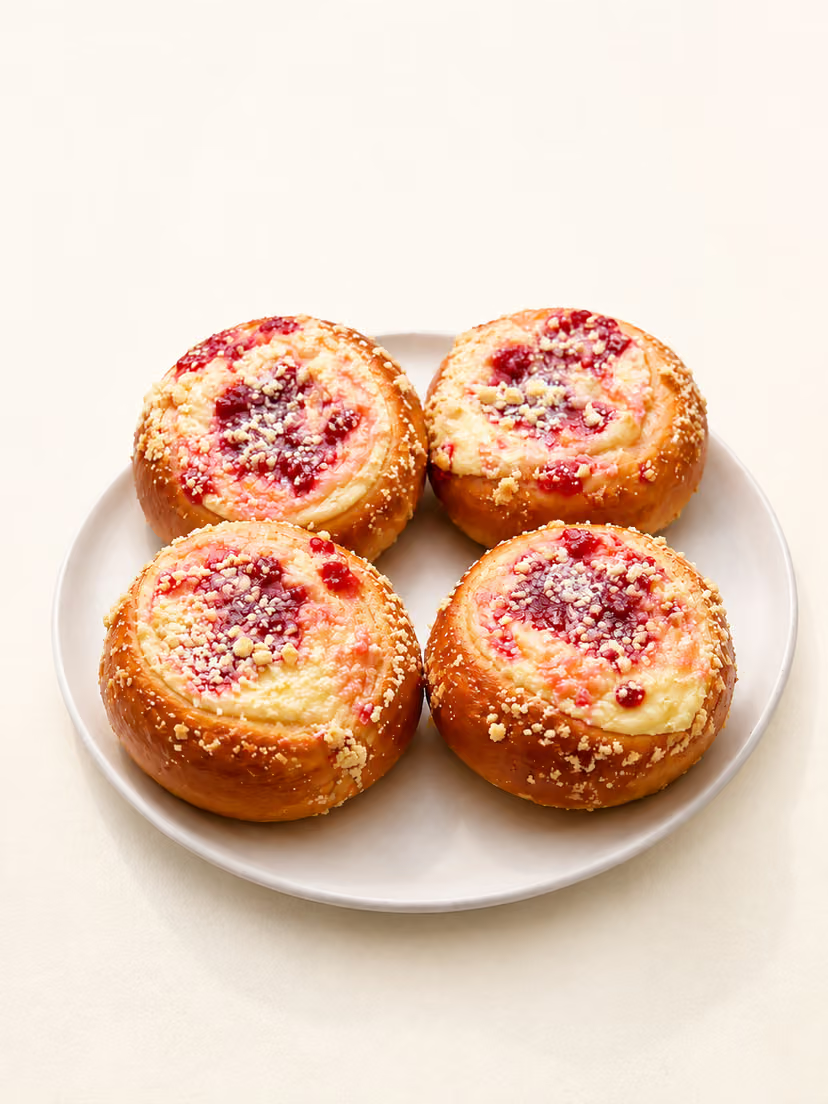
A jagodzianka is sealed. The dough is rolled into a disc, filled, gathered at the top and turned seam down so the fruit is fully enclosed, then finished with kruszonka, the rubbed crumble of flour, butter and sugar. Everything about it is defensive: the seal keeps the juice in, the crumble catches what comes out of the top anyway. The full account of the berry, the crumble and the Polish season is at what jagodzianki actually are, so one line will do here.
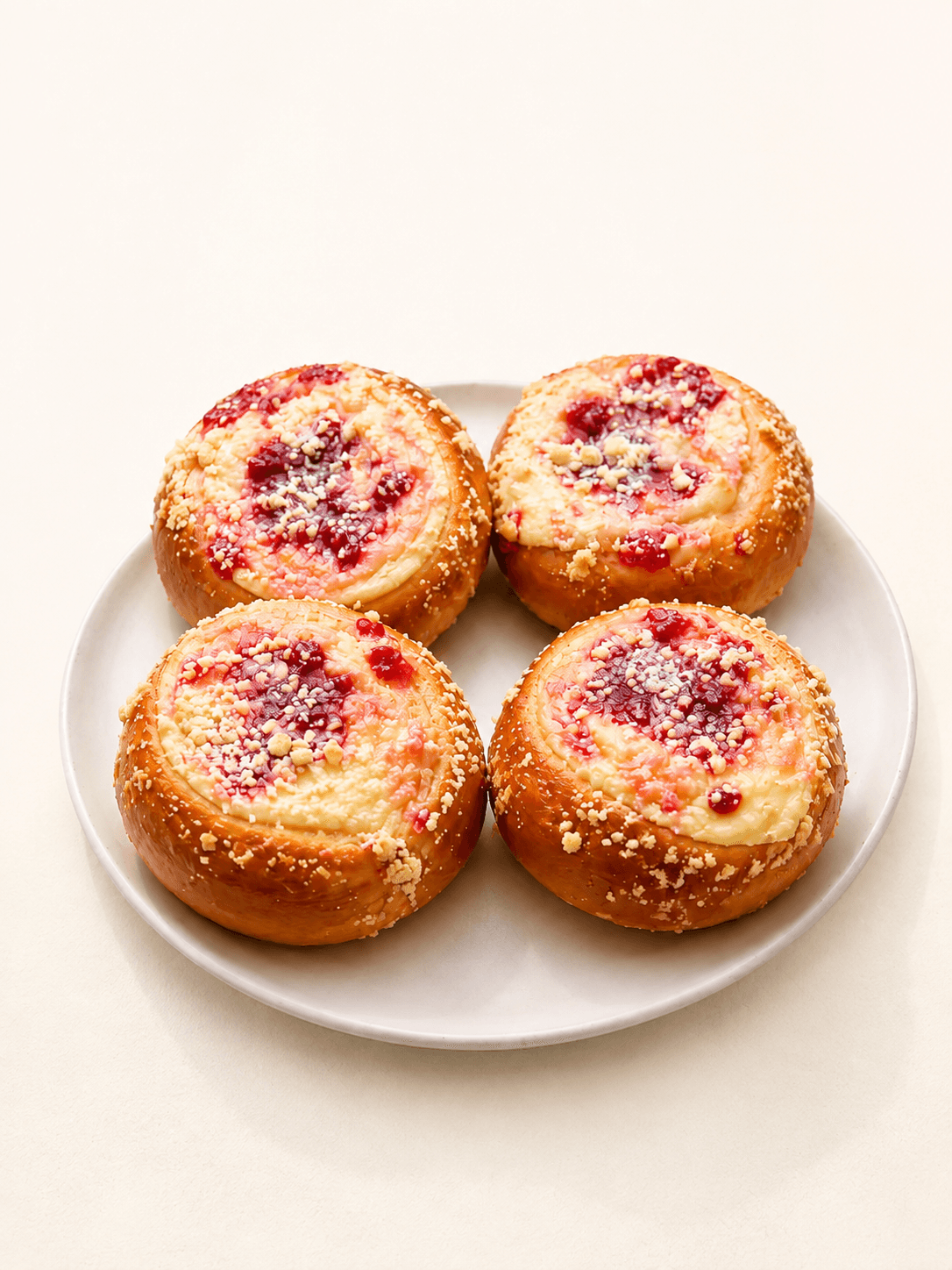
A vatrushka is the opposite decision. The dough is shaped into a round, the centre is pressed down with a glass or with the heel of the hand, and the well is filled so it stays visible through the bake. Nothing is hidden. The classic filling is tvorog, the fresh curd cheese, beaten smooth with sugar, egg yolk and vanilla, and the finished bun looks like a fried egg made of pastry. Wikipedia's entry on the vatrushka covers the regional variants, including the large family sized ones cut in wedges.
A plyushka has no filling to hide or display. The dough is rolled flat, brushed with butter, scattered heavily with sugar, rolled into a log and then folded and cut so that the layers open out as it proves. The Moscow version is the one most people picture: folded into a heart or a butterfly, the cut edges exposed so the sugar caramelises where it meets the oven. What you eat is dough, butter and sugar in ratio. There is nowhere for a weak dough to hide, which is why a bad plyushka is worse than a bad jagodzianka.
What each one is for
These buns do not compete. They occupy different hours.
The jagodzianka is seasonal and specific. In Poland it belongs to July and August, when bilberries come out of the forests, and Poles are firm that a jagodzianka sold in February is something else wearing the name. It is eaten fresh, often standing up, often with a glass of kefir or maślanka, because the sourness of the buttermilk cuts through the sugar and the fruit in a way that tea does not. It is a treat with a deadline attached.
The vatrushka is breakfast and it is year round. Curd cheese, a little sugar, some protein, something to eat at eight in the morning without feeling like you have had cake. In Russia and Ukraine it sits in the same slot as a croissant does in France, which is to say it is not thought about much, it is simply what is there. It also travels through the day well: a vatrushka at four in the afternoon with tea is entirely normal.
The plyushka is the everyday bun, the one bought for children on the way home, the one that costs the least and asks the least. No fruit to go off, no dairy filling to worry about, nothing that needs a fork. It is the bun you eat while walking. Because it has no filling, it is also the one that shows the baker's hand most clearly, and the one most likely to be dry if the dough was underproved or overbaked by three minutes.
Which one survives a lunchbox
This matters more than people expect, and the answer is not the one most customers guess.
The plyushka wins, comfortably. Nothing inside it can leak, the sugar glaze sets to a dry surface, and it can be wrapped in paper and carried in a bag all morning without marking anything. Our plyushki are £32 and want 48 hours' notice. If you are packing buns for a picnic, a car journey to Ascot, or a desk lunch for eight people, these are the ones that arrive looking the way they left.
The vatrushka comes second, with a caveat. The curd or cream sits in an open well, so it needs to be carried flat, and it needs to be kept cool. Our version is the strawberry vatrushki at £32, filled with vanilla cream and fresh strawberries rather than tvorog. That is a departure from the classic and I will say so plainly: if you grew up on grandmother's curd vatrushka, this is not that bun. It is a summer version, softer and sweeter, and the strawberries do bleed a little into the cream after a day. For the tvorog flavour proper, the sochniki at £25 for six are closer, since they fold curd into a short pastry rather than an enriched dough.
The jagodzianka comes last for portability, which is exactly what you would expect from a bun engineered to hold hot fruit juice. Our Blueberry Streusel Buns are £36 for a box of four and need only 24 hours' notice, the shortest lead time on the sweet side of the list. They are soft enriched buns filled with juicy blueberries under a buttery golden streusel crust. Two things happen in transit: the streusel sheds, and the fruit stains the crumb purple. Neither is a fault. The purple is the fruit doing what fruit does, and in Poland it is the proof the filling was real. Just do not put one in a bag with a white shirt.
Ordering all three, and what else sits near them
All three are made to order for a chosen date, which is the whole system here. Nothing is baked ahead and nothing waits on a shelf. Cakes need 48 hours, most buns and pastries need 24, and the blueberry buns are in the 24 hour group while the vatrushki and plyushki are in the 48 hour group because of how they are finished.
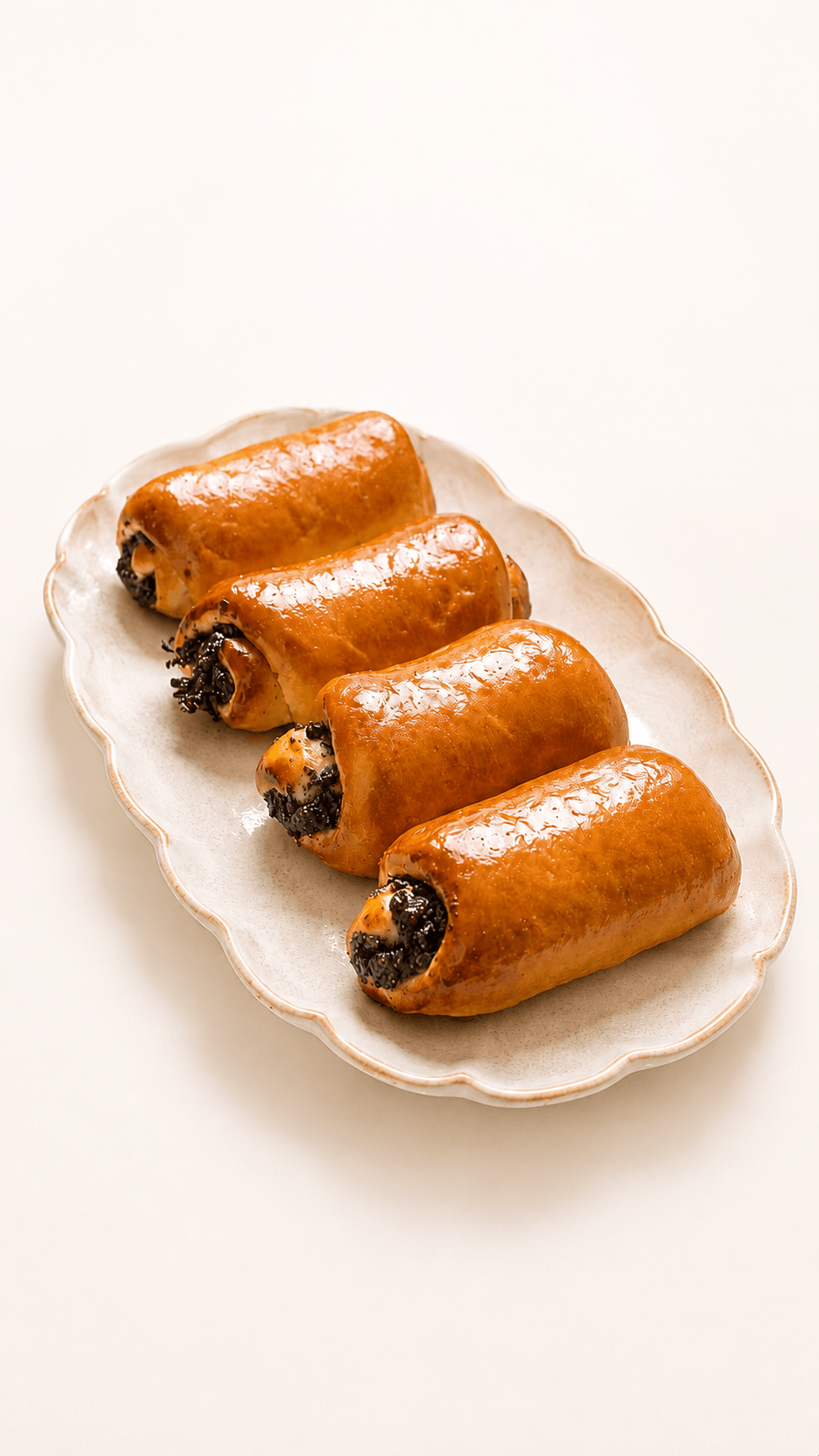
If you want a spread rather than one thing, the buns and babka section has the rest of the family: poppy seed buns at £30 for four, airy cinnamon buns at £32, and cinnamon rolls at £44 for six with a cream cheese glaze. Three boxes of four, one of each shape, feeds a table of eight or nine people with enough left for the following morning.
On the second day, all enriched dough goes slightly firm. This is normal and it is fixable. Four minutes in an oven at 150C brings the crumb back, and the plyushka improves more than the other two because the sugar softens again. Do not microwave them. Delivery areas and costs are set out at delivery, and orders go through info@mikebakes.uk or +44 7922 122149, Monday to Saturday.
If you have never eaten any of the three and want one box to judge by, order the blueberry buns in July or August, when the fruit is at its best, and eat one within four hours of it arriving.
Order it for the date you need
Everything here is baked to order for your date.
48 hours notice, 72 for bread. Delivered across London and Surrey.