
· 8 min read
Making Jagodzianki at Home, and Why They Are Harder Than They Look
A working recipe for Polish blueberry buns: dough quantities, two proves, how to thicken the fruit and seal a bun so it does not burst. Then an honest account of the three things that go wrong in a domestic oven.
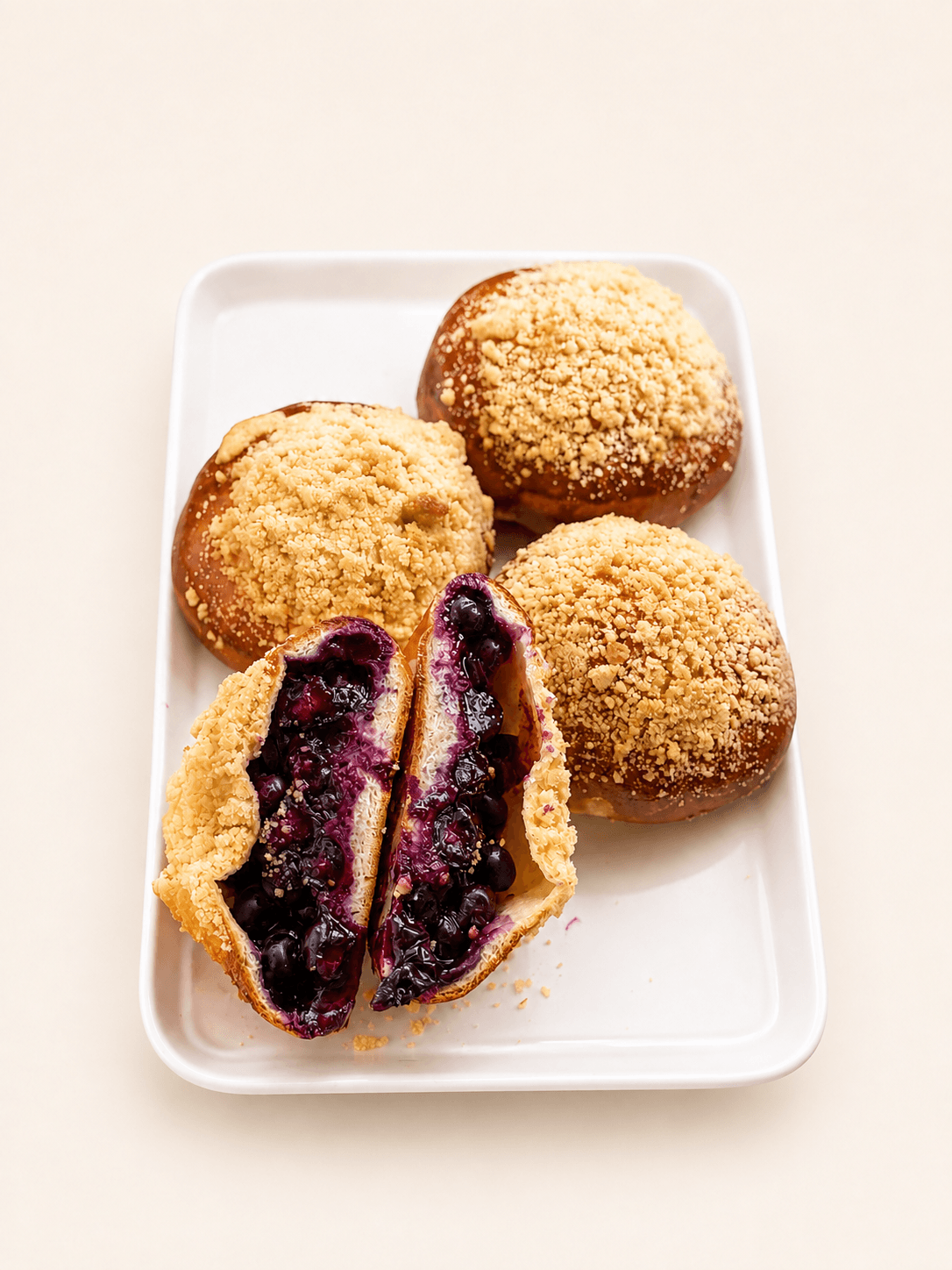
A jagodzianka is a sweet enriched bun wrapped around wild blueberries under a crumble lid called kruszonka, and the fruit, the crumble and the short July season are all set out in what jagodzianki are. This article assumes you already know that and want to make them. Below is a working recipe with real weights, followed by an honest account of the three things that go wrong in a home kitchen, including in ours when we started.
The recipe makes twelve buns of roughly 110 g finished weight. Read it through before you begin, because the fruit needs to be cold and the streusel needs to be made before the dough is shaped.
The yeast dough, and the numbers that matter
For the dough: 500 g strong white bread flour, 250 ml whole milk, 60 g caster sugar, 8 g fine salt, 7 g fast action dried yeast or 20 g fresh yeast, one whole egg plus two yolks, and 80 g soft unsalted butter.
Warm the milk to about 35C, no hotter. Whisk in the yeast and a spoonful of the sugar and leave it ten minutes until it foams. Put the flour, the rest of the sugar and the salt in a bowl, keeping the salt away from the yeast liquid until they meet in the flour. Add the egg, the yolks and the milk. Mix to a shaggy mass, then knead. Ten minutes by hand, or six to eight minutes in a stand mixer on low with the dough hook.
Only then add the butter, soft but not melted, in four or five pieces, waiting until each disappears. The dough will look ruined for a minute or two. Keep going. It comes back together and turns glossy. It is ready when a small piece stretches thin enough to see light through it without tearing. That is another five to eight minutes in a mixer, longer by hand.
The number worth caring about is the finished dough temperature: aim for 25C to 26C. Take it with a probe if you have one. Colder and the first prove drags on; warmer and the dough races ahead of you and tastes of yeast rather than of butter and milk.
First prove, covered, one hour to ninety minutes at normal room temperature, until roughly doubled. If your kitchen is 18C in November, it will take two hours, and there is no harm in that. A slower prove tastes better. You can also refrigerate the dough overnight after kneading and shape it cold the next morning, which is what most bakeries do and what makes a home version of a Polish blueberry buns recipe noticeably better.
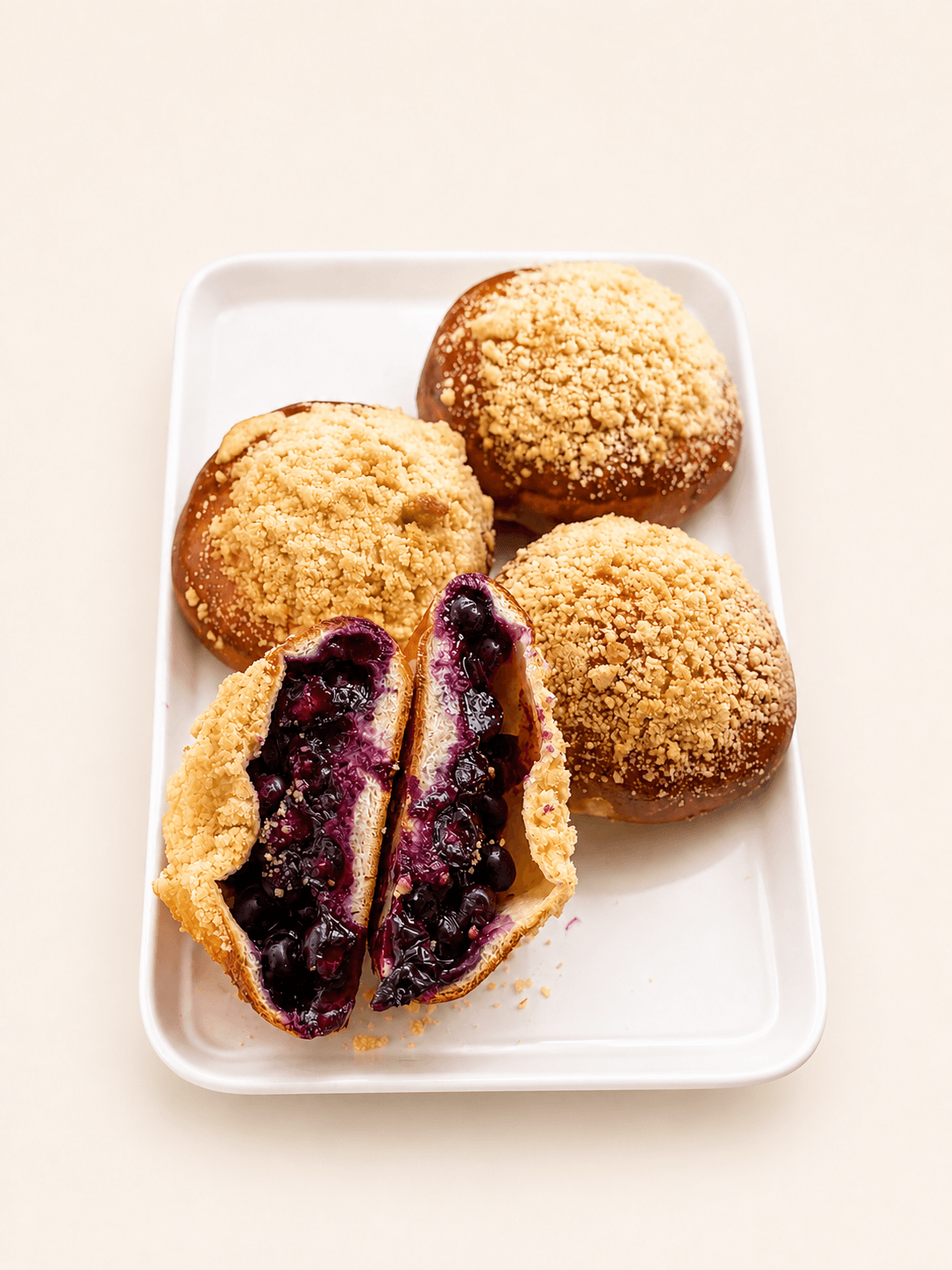 Blueberry Streusel Buns (Jagodzianki)Jagodzianki, Polish blueberry buns, four to a box. Soft enriched dough, blueberry filling, buttery streusel.£42Order this
A filling that stays inside the bun
For the filling: 500 g blueberries, 70 g caster sugar, 20 g cornflour or potato starch, a squeeze of lemon, a pinch of salt.
Berries are mostly water and they release it at exactly the moment the dough is at its weakest. Two ways to handle this. The first is to toss frozen fruit, still frozen and unthawed, with the sugar and starch so every berry carries its own thickener into the oven. The second, which is more reliable, is to cook half the fruit with the sugar and starch and 30 ml water until it thickens to a jam, take it off the heat, fold in the remaining raw fruit, then chill it thoroughly. Cold filling is easier to seal and slower to boil.
A teaspoon of fine semolina or dry breadcrumbs dropped into the dough before the fruit goes in absorbs whatever juice escapes the thickener. This is an old trick from Polish home kitchens and it works.
One honest note on fruit. A traditional jagodzianka is built on the forest bilberry, Vaccinium myrtillus, which is small, dark to the centre, sharp and prone to collapsing into purple juice. Cultivated punnet blueberries have thicker skins, more water, paler flesh and less acid, so a bun made with them is sweeter and milder and the crumb stays cream coloured rather than staining purple. Neither is wrong, but they are not the same bun, and it is worth knowing which one you are making. If you want the background on the two berries, Wikipedia's entry on the bilberry is accurate.
Kruszonka, shaping and the bake
For the streusel: 100 g plain flour, 60 g cold butter, 60 g caster sugar, a pinch of salt. Rub together with your fingertips until it forms crumbs the size of peas, then chill. Do not work it into sand. Big crumbs give the top ridge and shadow; fine crumbs melt into a flat sugary sheet.
Knock the dough back and divide it into twelve pieces of about 80 g each. Weigh them. Round each one, cover, rest ten minutes so the gluten relaxes, otherwise the discs fight back.
Flatten each piece to a disc of roughly 11 cm, thicker in the centre than at the edge. Put 40 g to 45 g of cold filling in the middle. That is less than you want to use. Use it anyway. Bring the edges up over the fruit, pinch them together in a firm seam, then pinch again along the whole length. Any gap wider than a pencil line will open. Roll the sealed bun gently under a cupped hand to round it, and set it seam side down on a lined tray with 5 cm between buns.
Second prove, covered, 40 to 50 minutes. They should look puffed and feel like a partly inflated balloon. A finger pressed into the side should leave a dent that fills slowly. Underproved buns tear along the seam in the oven; overproved ones deflate.
Egg wash with one yolk beaten with a tablespoon of milk, then press the chilled kruszonka onto the top and sides. Bake at 190C conventional or 170C fan for 18 to 20 minutes, until deep golden and 92C to 96C in the centre. Cool on a rack for at least 20 minutes, because the filling is molten and will burn a mouth for a good quarter of an hour.
Three things that go wrong at home
First, the seam. Most burst buns are not overfilled, they are badly sealed or proved seam upward. Fruit juice boils at just over 100C, finds the weak point and pushes. Pinch harder than feels necessary, chill the filling, and keep the seam underneath.
Second, the oven. Domestic ovens lose 20C to 30C the moment the door opens and take several minutes to recover. In that window the buns spread instead of setting, the base goes pale, and the fruit has longer to boil before the crust is strong enough to hold it. Preheat for a full 20 minutes past the beep, bake on a preheated tray or a stone if you have one, and do not open the door in the first 12 minutes. A fan oven dries the streusel before the crumb is cooked, which is why the fan temperature above is lower.
Third, dough temperature and time. A warm kitchen in August pushes an enriched yeast dough through its first prove in 45 minutes, and buns made from it taste thin and go stale by evening. A cold kitchen in February leaves the dough sluggish and heavy. Neither is a fault of the recipe. Watch the dough, not the clock, and use the overnight fridge prove when you can.
What a bakery does differently
None of it is magic. Dough is mixed to a target temperature and checked with a probe. Pieces are weighed rather than eyeballed, so twelve buns bake at the same rate. Proving happens at a controlled temperature instead of on top of a radiator. The oven holds its heat because it is heavy and rarely opened, and the base sets in the first three minutes, which is the whole difference between a bun that keeps its shape and one that leaks. And everything is made for a date, so the buns are eaten within hours of coming out rather than the following afternoon.
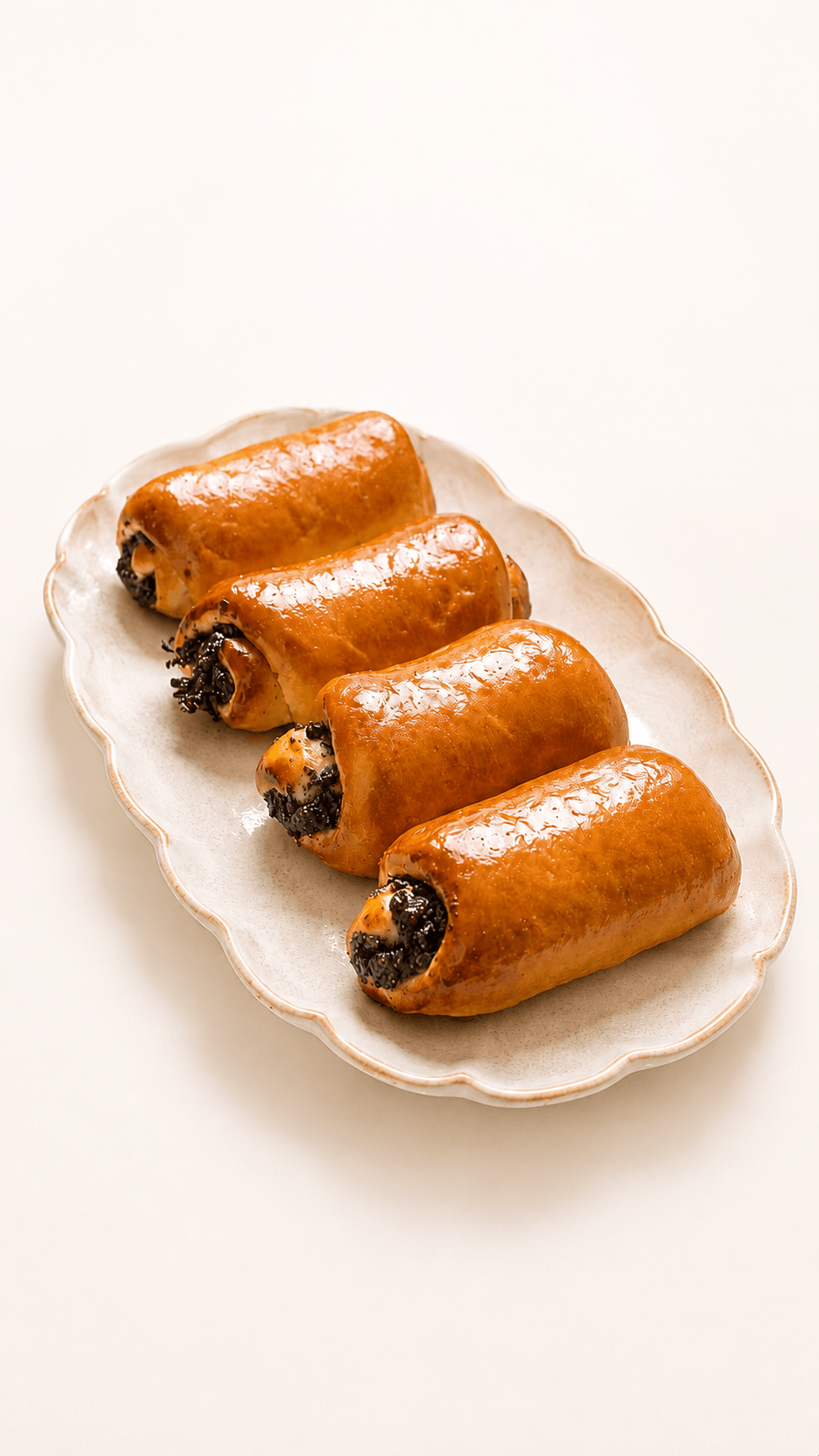
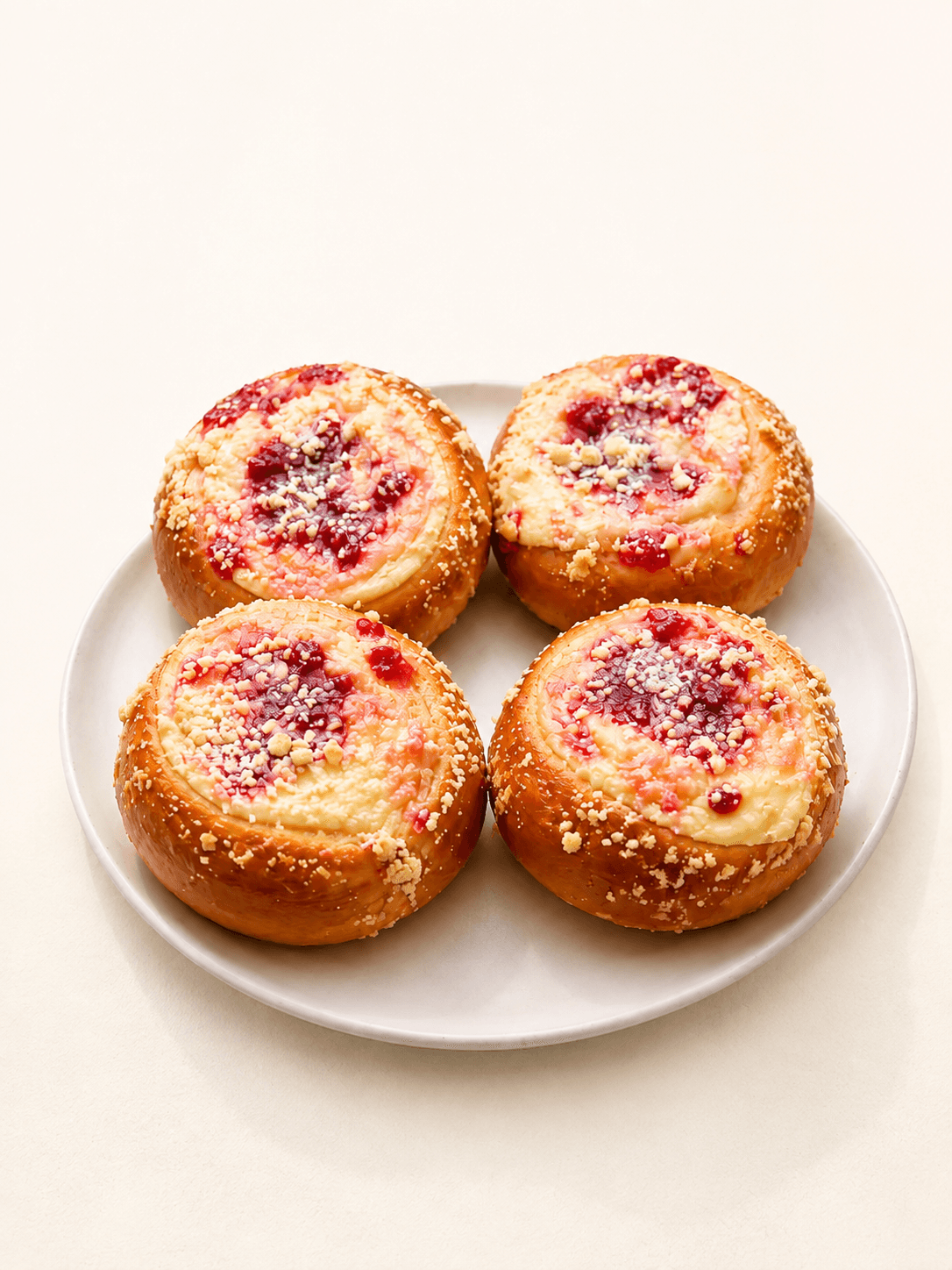
Our own Blueberry Streusel Buns are £36 for four with 24 hours' notice, delivered across London and Surrey. We use the name jagodzianki on the site because that is what they are modelled on, with one difference stated plainly: ours are made with cultivated blueberries, which are larger, sweeter and milder than the forest bilberry a Polish jagodzianka is built on. They sit alongside the poppy seed buns, the strawberry vatrushki and the cinnamon rolls in the buns and babka section.
If you bake the recipe above and it works, you have twelve buns for the cost of a bag of flour and a punnet of fruit, and that is a better outcome than anything we could sell you. If the first batch bursts, halve the filling to 35 g, chill it harder, and try again on a Saturday morning with the dough proved overnight in the fridge. The second batch is usually the one that works.
Order it for the date you need
Everything here is baked to order for your date.
48 hours notice, 72 for bread. Delivered across London and Surrey.