· 5 min read
Traditional Eastern European Cakes to Try in London
Six cakes with unfamiliar names, explained properly. What each one actually tastes like, where it came from, and which to start with.
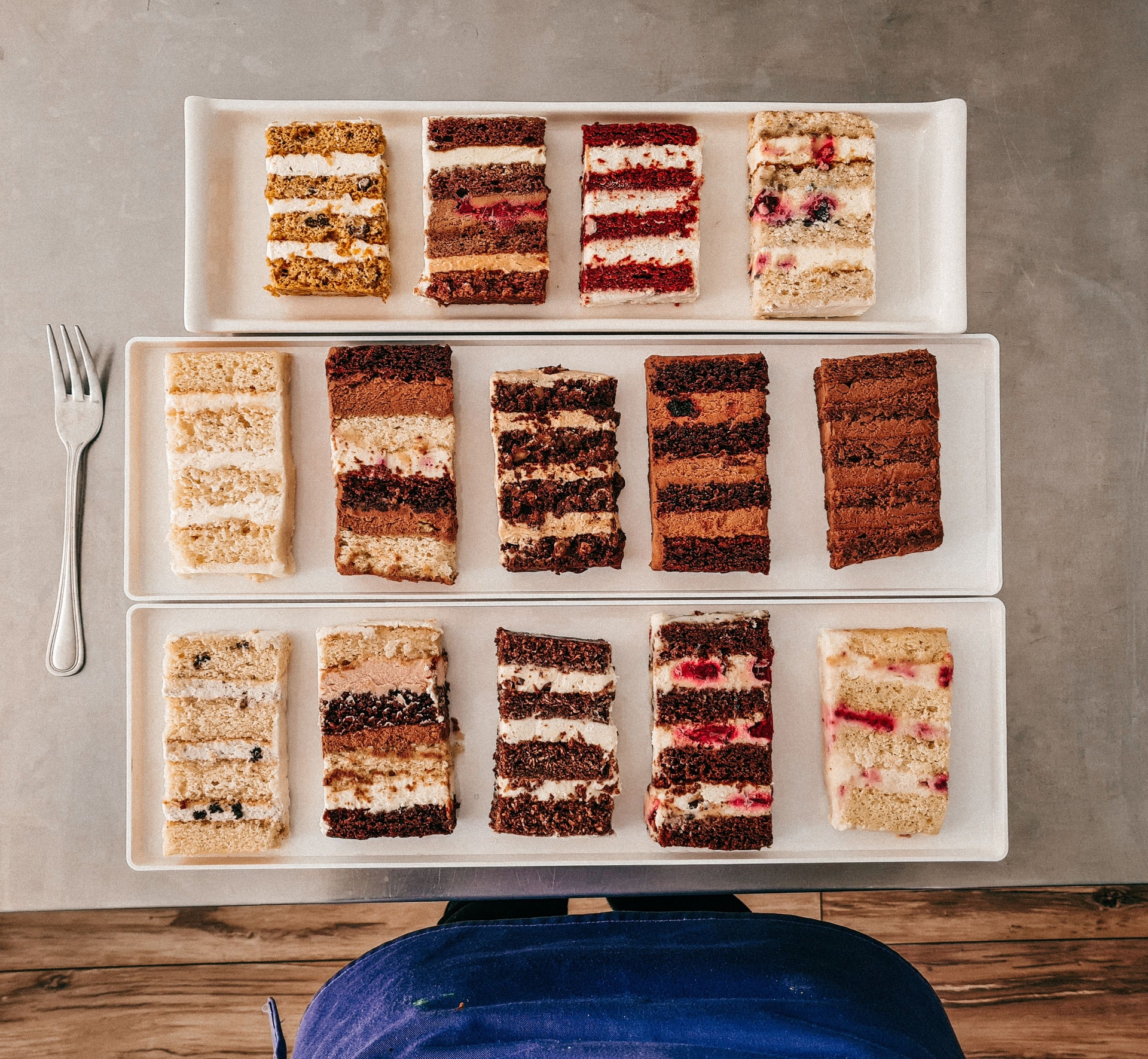
If you have not grown up with them, the names are no help at all. Medovik, Ptichye Moloko, Charodeyka. Even translated they raise more questions than they settle, because Bird's Milk and Enchantress do not describe anything you can picture.
So here are six of them, described as if you had never heard of any of them, with some idea of which to start with.
Medovik, the honey cake
The one to begin with, and the one most people already half know.
Eight thin layers of honey sponge with soured cream between them. The sponge is made by cooking honey, sugar and butter together until it darkens, which gives the finished cake a deep caramelised flavour rather than a straightforward honey sweetness. The soured cream is kept sharp so it cuts against it.
Assembled it is firm. Left overnight it softens into a single tender thing, which is the whole point and the reason it needs 48 hours.
It tastes warm, slightly sour, not very sweet, and unlike anything in the British or French repertoire. If someone in your house is nervous about unfamiliar food, this is still the safe bet. Nobody dislikes it. £68.
Kyiv cake, the meringue and hazelnut one
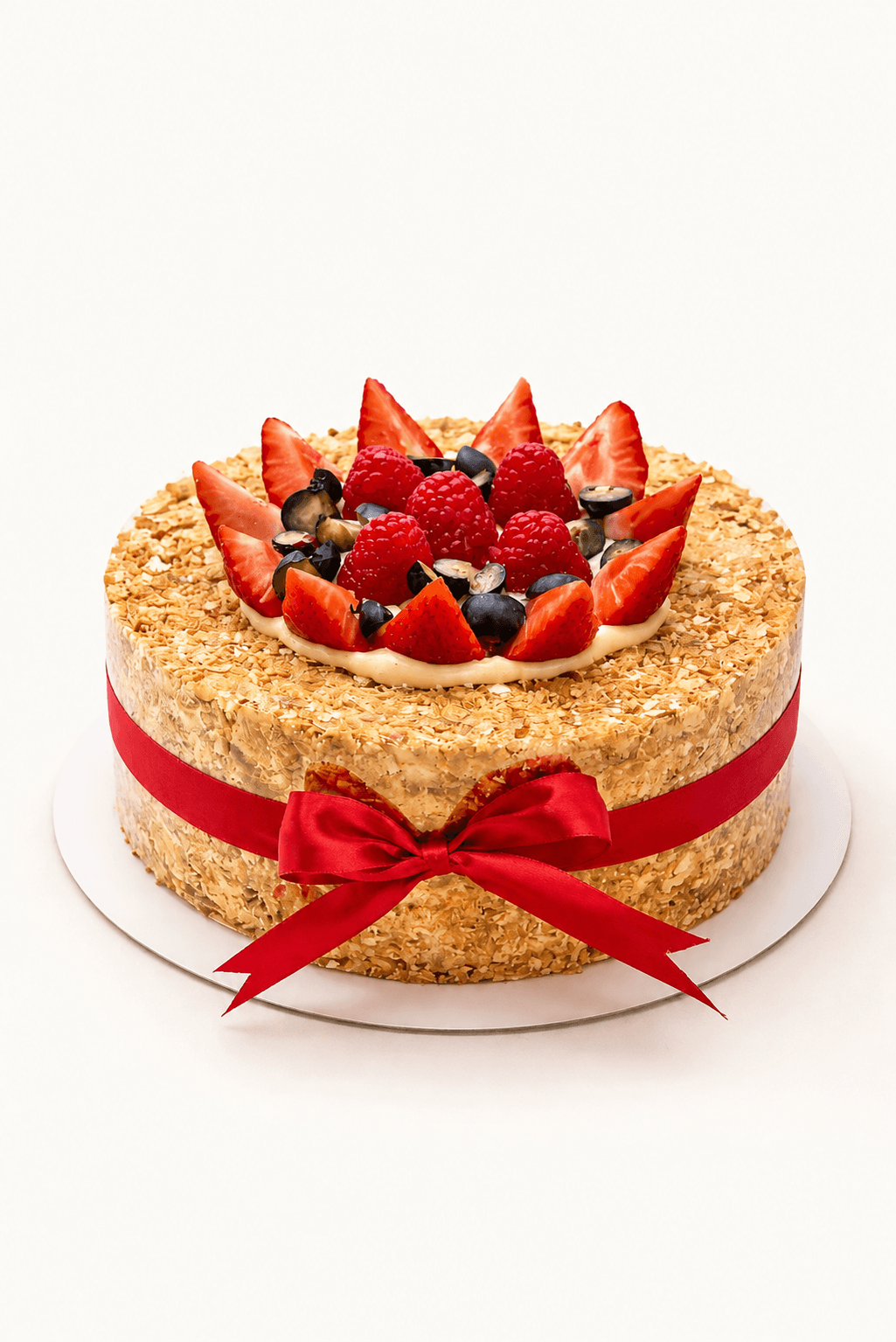
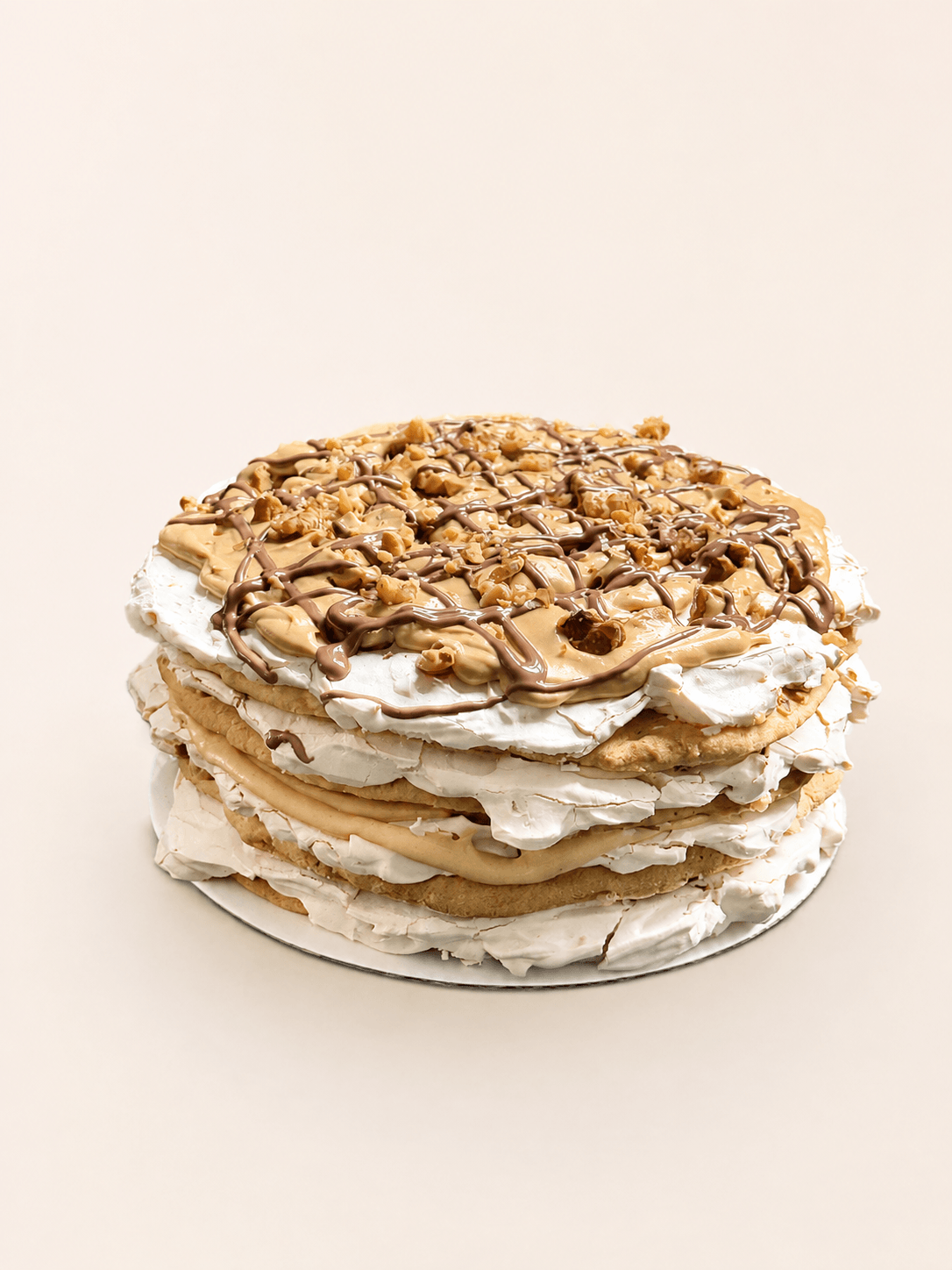
Created at a confectionery factory in Kyiv in 1956, and now the cake Ukraine is best known for. For decades people carried boxes of it home in hand luggage because it was not available anywhere else.
Two discs of meringue studded with hazelnuts, baked slowly until dry the whole way through, sandwiched with buttercream. The texture is what people remember. Fresh from the oven the meringue shatters. After several hours against the buttercream it softens to something that gives way under the fork instead.
Sweeter than the medovik and considerably richer. Slices get cut small. If you like praline, hazelnut and buttercream, this is the one. £80.
Prague cake, the chocolate one
Nothing to do with Prague. It was developed at the Prague restaurant in Moscow in the 1970s, loosely modelled on Sachertorte, and then went its own way.
Three layers of cocoa sponge soaked in syrup, chocolate cream between them, apricot jam under a poured chocolate glaze.
The jam is the part that makes it work. Without it the cake is chocolate stacked on chocolate and it sits heavily. The thin sharp fruit layer under the glaze breaks it up, which is why you go back for a second slice instead of putting your fork down after four mouthfuls.
This is the cake for someone who says they want chocolate cake and means it. £75.
Bird's Milk, the set soufflé one
Ptichye Moloko, invented in Moscow in the 1960s, and the name is a joke. Bird's milk was a Russian expression for something so rare it does not exist.
A thin sponge base with a set soufflé layer over it, thick and pale, somewhere between a mousse and a marshmallow but not quite either. Over that goes dark Belgian chocolate, poured warm so it sets into a shell that cracks cleanly under a knife.
The texture has no real equivalent in Western baking, which is why it is difficult to describe and why people who grew up with it get so attached. It is lighter than it looks and the chocolate keeps it from being sickly.
Order this one for someone from the former Soviet Union and watch their face. £78.
Esterházy, the gluten free one
Hungarian, nineteenth century, named after a member of the Esterházy family. It is gluten free by construction rather than by substitution, because the recipe never contained flour in the first place.
Five discs of almond meringue, baked dry, layered with buttercream. The top is glazed white and combed by hand into the feathered chevron pattern the cake is known for, which has to be done in one pass while the icing is still wet.
Rich, nutty, and quite sweet. What makes it useful is that nobody at the table works out it is a free from cake unless somebody tells them, which is not something you can say about most gluten free baking. £75.
Charodeyka, the everyday one
The name means enchantress. In the Soviet Union this was a shop cake rather than a home cake, which is exactly why people are fond of it.
Airy sponge, soft custard cream through the middle, chocolate glaze poured over the top. There is nothing clever in it and nothing to explain.
At £50 it is the least expensive cake we make, and it is the one to order if you want to try something without committing £80 to it, or if you have children who will eat cake and ignore everything you say about its history.
Keeping and serving them
All six live in the fridge, and all six are better out of it. Twenty minutes on the counter before you cut makes a real difference, particularly to the Prague and the Kyiv, where cold buttercream mutes almost everything.
They keep differently. Medovik and Napoleon improve on day two and are still good on day three. Prague holds for three or four days without complaint. Kyiv and Esterházy last well because meringue and buttercream are stable, though the crunch in the Kyiv gradually disappears. Bird's Milk is best within two days, as the soufflé slowly loses its set.
Cut with a sharp knife pressed straight down rather than dragged. The Bird's Milk needs a knife run under hot water and wiped between slices, otherwise the chocolate shell cracks in the wrong places and takes the soufflé with it.
Where to start
If you are buying for other people and you do not know their tastes, order the medovik. It is the most universally liked and the most distinctive, so it does both jobs at once.
If you want the chocolate one, take the Prague. If somebody at the table cannot eat gluten, the Esterházy solves the problem without drawing attention to it. If you are shopping for someone with a specific childhood, Bird's Milk and Kyiv are the two that carry the most weight.
All of these are 18 cm, serve ten to twelve, and need 48 hours notice. We bake them in Belgravia and deliver across London and Surrey. Delivery is £12 within SW3 and £15 elsewhere, with a £50 minimum on orders.
Order it for the date you need
Everything here is baked to order for your date.
48 hours notice, 72 for bread. Delivered across London and Surrey.