· 6 min read
Where to Order Napoleon Cake in London
There are two Napoleons, and people are usually loyal to whichever one they grew up with. This explains the split and where ours falls.
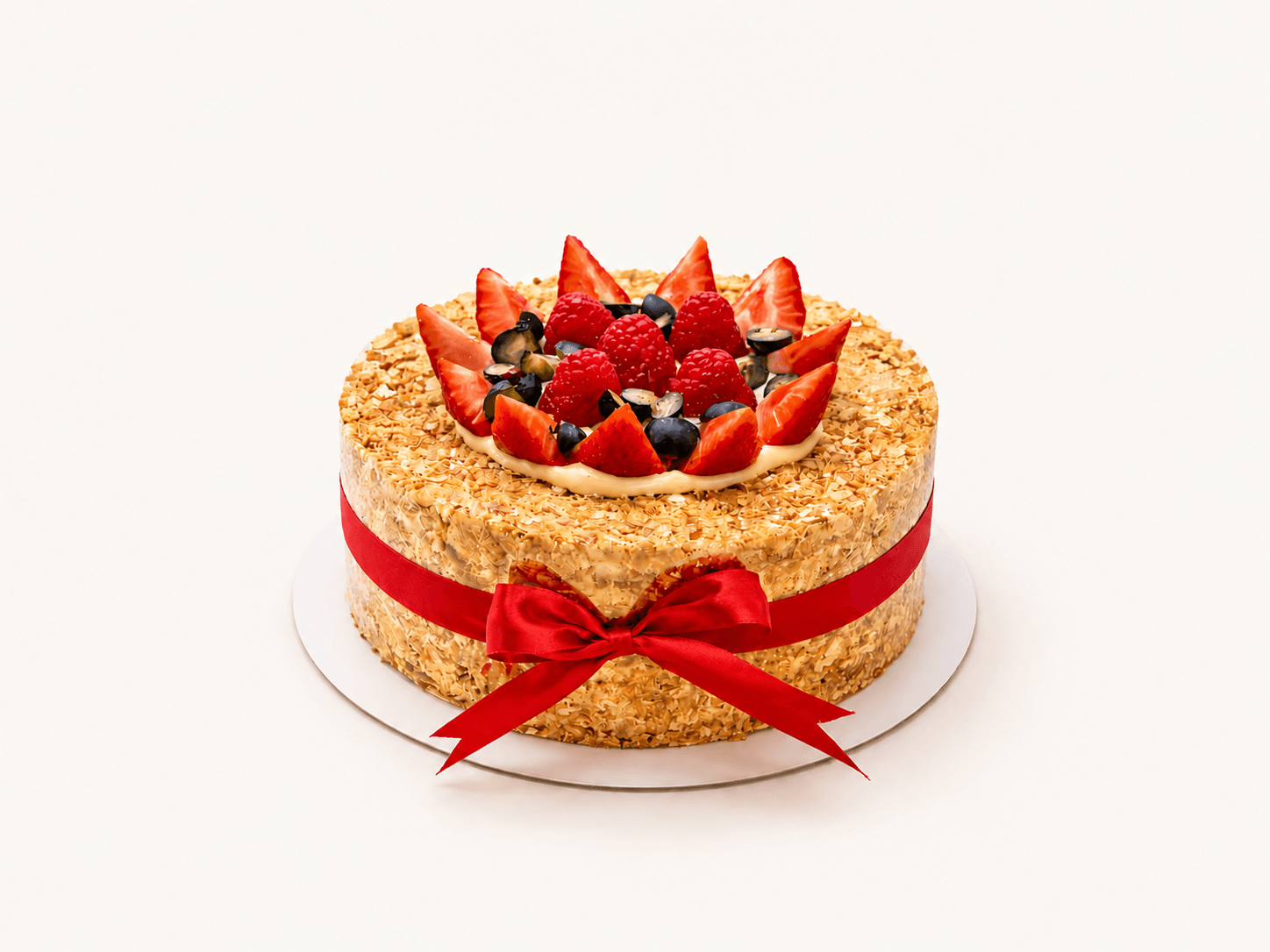
Order a Napoleon in Paris and you get a millefeuille: three sheets of puff pastry, crisp enough to shatter under the fork, with pastry cream between them and a glazed top. Order a Napoleon in Kyiv, Moscow or Warsaw and you get something that looks similar and eats completely differently. More layers, no glaze, and pastry that has gone soft all the way through.
People are usually loyal to whichever one they met first, and the argument between the two camps is more heated than the subject strictly warrants.
Where the name comes from
The Russian version has an origin story attached to 1912, the centenary of Napoleon's retreat from Moscow. Bakers are said to have made a triangular layered pastry to mark the anniversary, cut to resemble a bicorne hat, and the name stuck.
Like most such stories this is probably tidied up after the fact. Layered pastries with cream were being made across Europe well before 1912, and the French had been calling theirs a millefeuille for a century. But the name Napoleon did settle in the Russian speaking world and never left, and the cake developed there in its own direction.
That direction was away from crispness.
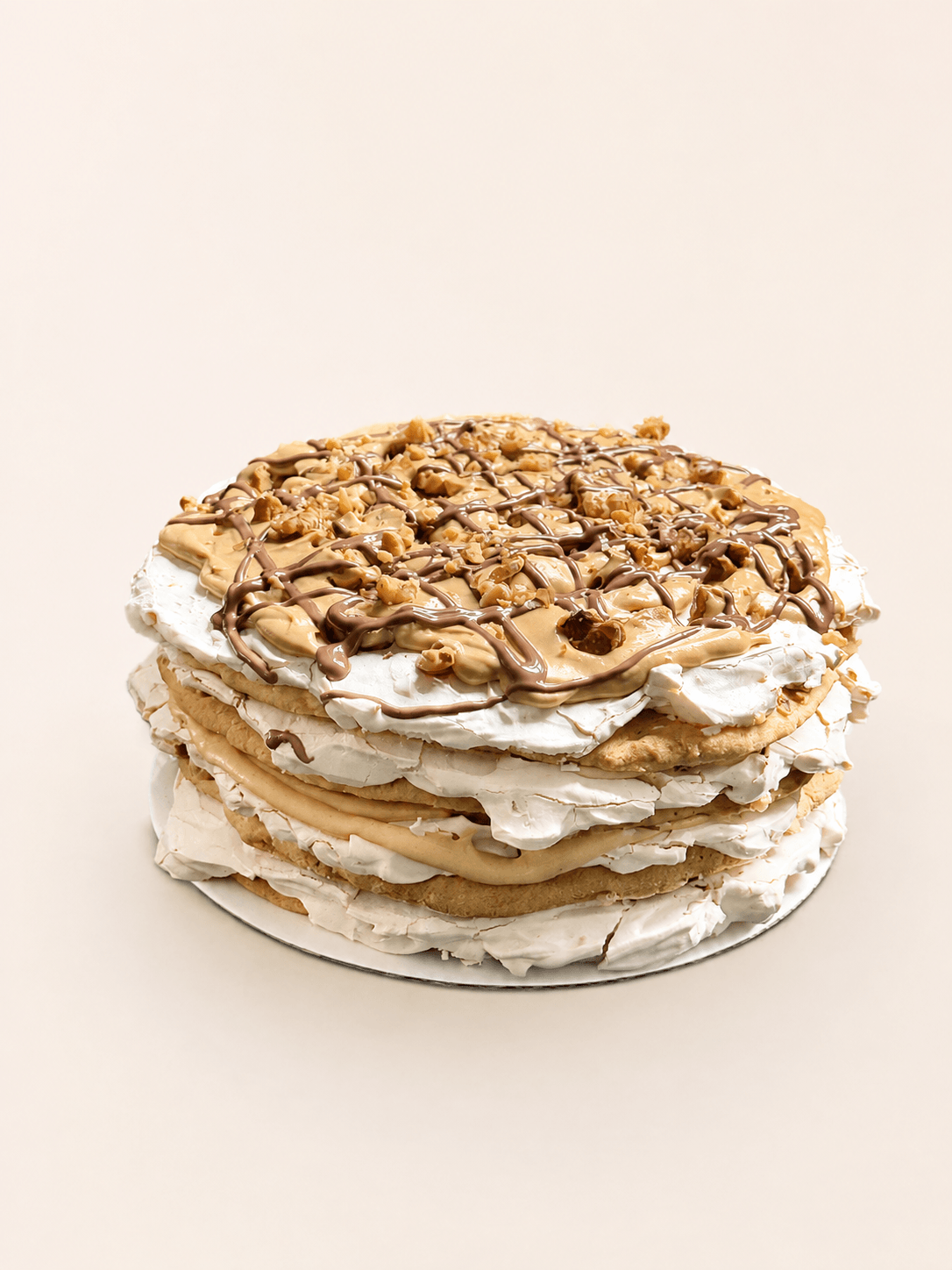
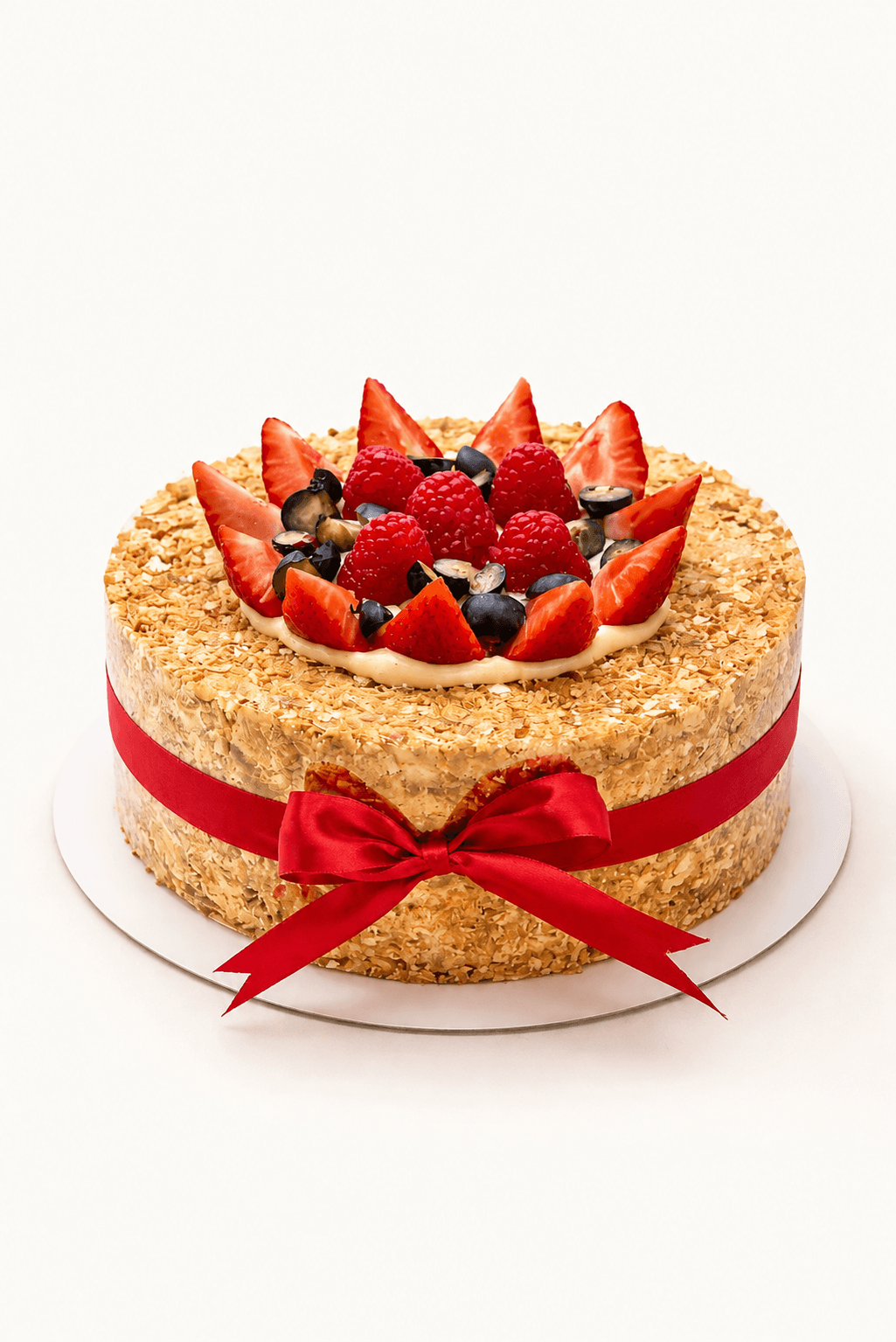 Napoleon Cake (18cm)Napoleon cake, 18 cm. Crisp puff pastry layers with vanilla custard cream, rested so the layers soften.£86Order this
The soft school
The Eastern European Napoleon has more layers than the French version. Where a millefeuille has three, a Napoleon might have eight, ten or more, each rolled thin and baked separately.
Between them goes a custard cream, usually thicker and less sweet than French pastry cream. The cake is assembled, weighted lightly, and left overnight.
In that time the moisture moves out of the cream and into the pastry. The layers lose their snap. By morning the whole cake is tender, and a fork goes through it without any resistance at all. The top is finished with crushed pastry trimmings rather than a glaze, which gives it a rough, homely look quite unlike the sharp geometry of a millefeuille.
To someone raised on the French version this sounds like a description of a cake that has gone wrong. To someone raised on the Eastern European one, a crisp Napoleon is a cake that has not been finished.
Which is better
Neither, though we have picked a side.
A millefeuille is a technical achievement. Keeping puff pastry crisp under wet cream is genuinely difficult and it only works for a few hours, which is why the good ones are assembled to order in a patisserie and eaten there. It does not survive delivery. Put a millefeuille in a box, drive it across London, and by the time it arrives it is a soft Napoleon anyway, only one that nobody intended.
The Eastern European version is built for the way people actually eat cake at home. It is designed to be made the day before, kept in the fridge, and eaten over two or three days. It gets better on the second day and it is still good on the third.
We make the soft one. Partly because it is what our customers ask for, and partly because it is the only honest thing to send out in a van.
How ours is made
Puff pastry, made here, rolled and baked as separate rounds rather than as one block that gets cut. Each round is docked and baked until deep gold, because underbaked puff goes greasy rather than tender when it softens.
The cream is a vanilla custard, cooked and cooled, then beaten with butter to a consistency that holds its shape but is not stiff. It is less sweet than most, which matters in a cake with this many layers, because sweetness accumulates.
Assembled, weighted, rested overnight, finished with crushed pastry over the top and around the sides. Nothing else. No glaze, no fruit, no chocolate.
It is 18 cm and it serves ten to twelve, though it is rich enough that people usually cut smaller slices than they mean to. It costs £85, and it needs 48 hours notice, most of which is the resting rather than the making.
Serving it
Take it out of the fridge twenty minutes before you cut it. Straight from cold the cream is firm and the flavour is muted, and it improves noticeably as it comes up.
Use a sharp knife and a single downward press rather than a sawing motion. Sawing drags the layers sideways and the slice arrives on the plate looking as though it has been in an accident.
It keeps in the fridge for three days, covered. It does not freeze well, because the pastry has already given up its structure and freezing takes what little is left.
It needs nothing alongside it. Berries are pleasant if you want them. Cream would be absurd.
Who it suits
Napoleon is a good cake for a room of adults and a poor one for a children's party. There is no chocolate, no colour and nothing to look at, and children reliably choose the Charodeyka or the carrot cake if both are on the table.
It is also the cake to order when you want something that will still be worth eating for the rest of the week. Most of what we make is best within a day or two. Napoleon holds for three days in the fridge and does not noticeably decline, which makes it sensible for a small household or for a birthday where the celebrating goes on across a weekend.
For a dinner party it does one further useful thing. Because it is rich and because the slices are cut small, an 18 cm cake will comfortably see off twelve people at the end of a long meal, where a lighter cake of the same size would only manage ten.
Ordering one in London
The Eastern European Napoleon is not hard to find in London if you know where to look, and it is nearly impossible to find if you do not. A handful of Russian and Ukrainian delis carry one, usually made off site. Some Eastern European bakeries in the north and east of the city make their own.
Ours is baked in Belgravia and delivered across London and Surrey, £12 within SW3 and £15 to everywhere else we cover, which includes all London postcodes and much of Surrey, Kent and the Home Counties. There is a £50 minimum on all orders.
Choose a delivery date at least 48 hours ahead. It contains gluten, eggs and milk.
If you grew up with this cake, you will know within one forkful whether we have got it right. That is a slightly nerve wracking thing to sell, and it is also why we bother.
Order it for the date you need
Everything here is baked to order for your date.
48 hours notice, 72 for bread. Delivered across London and Surrey.