
· 5 min read
Why We Need 48 Hours
The 48 hours is not administrative. For several of our cakes, the resting is the last stage of making them rather than a wait after they are finished.
The most common question we get is whether the 48 hours is really necessary, usually from somebody who needs a cake tomorrow and is hoping we will say no.
It is necessary, and the reason is more interesting than a scheduling constraint. For several of our cakes, what happens overnight is not waiting. It is the last stage of making them.
What starch actually does
A sponge layer comes out of the oven with its starch gelatinised and its structure set. It is dry to the touch and firm.
Put a wet filling against it and moisture starts moving from the filling into the layer, drawn in by the starch. This takes hours. As it happens the layer softens, its structure loosens, and the boundary between layer and filling stops being a boundary.
There is no way to accelerate this that does not ruin something. You cannot soak the layers first, because they turn to paste and the cake collapses. You cannot use a wetter filling, because it runs out of the sides. Heat does not help. It simply takes the time it takes.
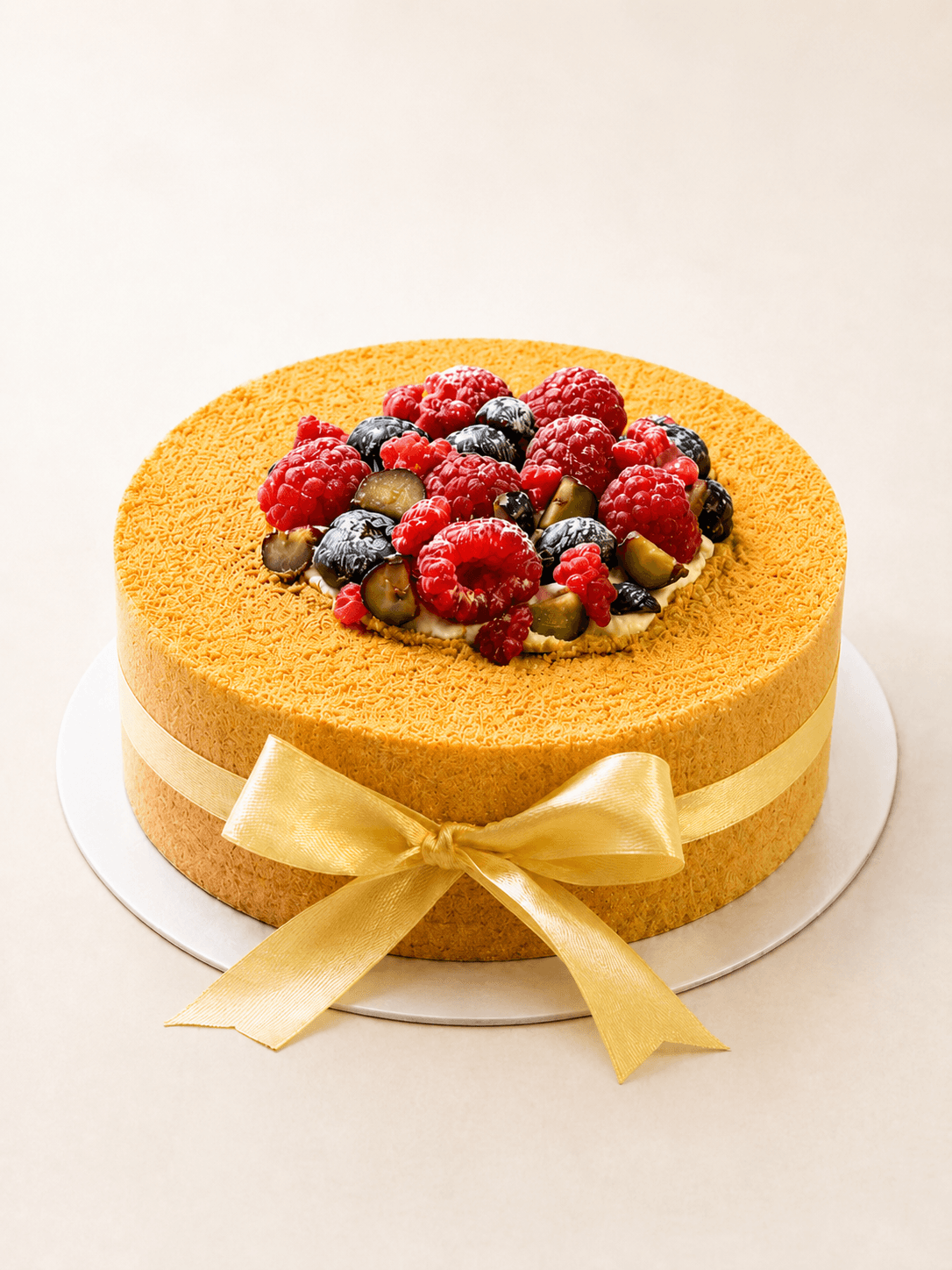
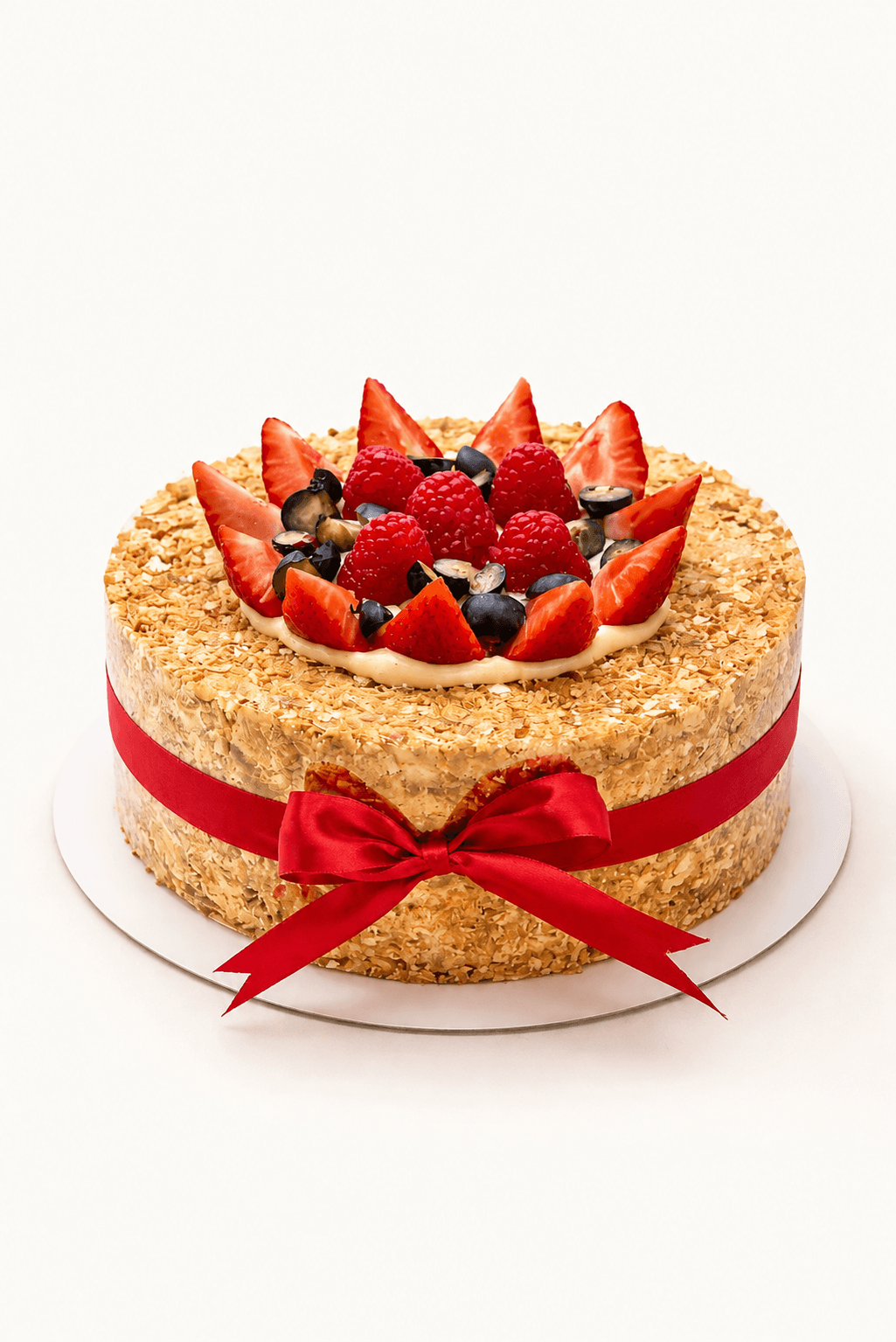
For a medovik, this is the difference between a stack of honey biscuits and a cake. For a Napoleon it is the difference between a millefeuille and the thing people from Kyiv and Moscow are actually asking for.
The two day rhythm
Day one is baking. For a medovik that means cooking honey, sugar and butter together until it darkens and foams, working in flour and egg, then dividing the dough and rolling eight discs thin enough to matter. Each is baked separately for a few minutes and trimmed while still warm, because once cooled it snaps rather than cuts. The trimmings are kept and crushed for the outside.
Then the cream, then assembly, then into the fridge.
Night one is the rest. Nobody touches it. This is the part being paid for that nobody can see.
Day two is finishing and delivery. The cake is crumb coated, checked, boxed and sent.
Two days, and only about six hours of it is work.
Which of ours need it and which do not
Absolutely need it. Medovik, Napoleon and Kyiv. All three are unfinished without the overnight rest and all three would be sent out worse if we skipped it.
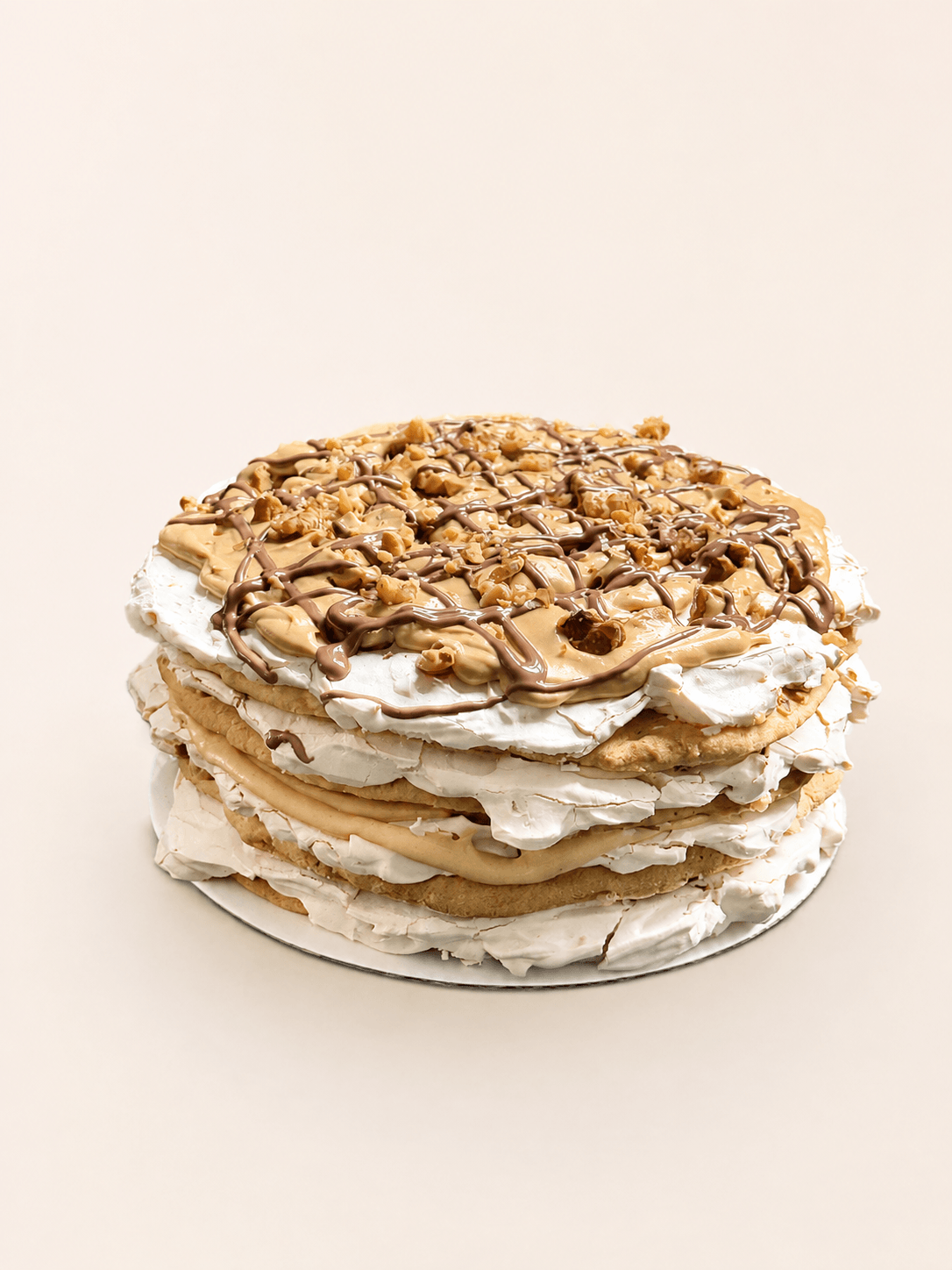
Benefit from it. Prague, where the syrup soaked sponge continues to even out. The carrot cake, which is genuinely better on day two. The Esterházy, whose meringue layers soften gradually against the buttercream.
Do not need it and get the time anyway. The pavlova, which is assembled as late as possible. The choux, filled the morning they go out. The strawberry cake, which is built fresh.
For that last group the 48 hours is honestly about scheduling rather than chemistry. We bake in batches, everything for a given day is planned together, and a small kitchen cannot absorb an order that arrives at four in the afternoon for the following morning.
We could offer 24 hours on the pavlova and 48 on the medovik. It would confuse everybody and it would break the batching that lets a small operation produce fifty different things.
Why bread is 72
Bread is a longer process again.
A sourdough starter has to be fed and brought to peak, which is twelve hours of waiting. The dough is mixed, rested, folded at intervals across several hours, shaped, and given a long cold proof overnight. Only then does it bake.
That process also cannot share a day with cakes. Bread wants a very hot oven with steam, cakes want moderate heat, and both want the same bench and the same pair of hands. So bread gets Wednesdays, and Wednesdays only, at 72 hours notice.
What we lose by working this way
A great deal, honestly.
Every impulse purchase. Nobody has ever ordered from us because they walked past. Every same day emergency, which is a large and lucrative part of the cake business in a city like London. Every customer who finds the 48 hours annoying enough to go elsewhere, and there are some.
We also cannot do next day, which people ask for more often than same day and which we still cannot offer.
What it lets us do
Carry things a shop could not. Liver pirozhki sell steadily to a small number of people and would sit unsold on a counter. The gluten free peach pie, made without sugar or lactose either, exists because people asked and because we do not have to make twelve and hope.
Send everything at its right moment. The pavlova is assembled hours before it arrives. The choux are filled the same morning. The strawberry cake is only made when the strawberries are worth eating, and comes off the site entirely when they are not.
Waste almost nothing. A retail bakery throws away something between a tenth and a fifth of what it makes, and that gets priced into everything on the counter. We make what has been ordered.
The one thing that cannot be bought back
Time is the only ingredient we cannot buy more of at short notice.
We can get better honey, better chocolate, better vanilla. Those are decisions about cost and we have made them where they matter, which is why the choux use Madagascan vanilla and the Bird's Milk uses Belgian chocolate.
Overnight is not for sale. A cake that has rested twelve hours is different from one that has rested two, and no supplier can shorten that. It is the one part of the process where money is no help at all, and it is why the notice period is the thing we will not move on when everything else is negotiable.
The practical advice
Order for the day before your event. Not the day of it. Almost everything is fine after a night in the fridge, several things are better, and you will not spend the morning of a party watching for a van.
Give yourself more than 48 hours if you can. The calendar allows the minimum. It does not make the minimum a good idea.
For anything large, allow weeks. Weddings, big celebrations, anything above about twenty five people. That is a conversation, not a checkout.
If you need a cake tomorrow, we cannot help, and we would rather say so than take the order and send you something we are not happy with.
Order it for the date you need
Everything here is baked to order for your date.
48 hours notice, 72 for bread. Delivered across London and Surrey.