
· 7 min read
An Eastern European Bakery in London: What to Order First
Six things worth ordering first from a small Belgravia kitchen that bakes Russian, Polish and Ukrainian classics to order, with prices, notice times and who each one suits.
Most people who find this site arrive looking for one specific thing: a medovik for a birthday, blueberry buns in July, six pirozhki for an office lunch. A smaller group arrives without a plan. They have heard the names, or they have a Polish colleague, or they ate something once in Warsaw or Riga and never learned what it was called. This is for the second group, and for the first group when they want to add something to the box.
One practical thing before the list. This is a kitchen in Belgravia, not a shop with a counter. Nothing sits on a shelf waiting. Everything is baked for the date chosen at checkout, cakes need 48 hours' notice and most buns and pastries 24, and delivery covers London and Surrey. The whole collection is at our cakes page, and the six below are where I would send somebody who has never ordered before.
Honey cake, the one to order if you order only one thing
Medovik is the cake that decides whether somebody likes Russian baking. Thin layers of honey sponge, baked one at a time, stacked with a light sour cream frosting, then left overnight so the layers drink the cream and turn soft. Cut on the day it is baked it is a stack of biscuits. Cut the next day it is a cake. That resting time is not a flourish, it is the recipe, and it is one of the reasons the 48 hours exists.
Ours is 18 cm and £65 to £68 depending on nothing more complicated than the size you see listed: the honey cake is £68. It is not a sweet cake by British standards. The sour cream cuts the honey hard, and people who expect frosting sweetness are sometimes surprised on the first forkful and converted by the third. If there is one thing to try first, it is this. If you grew up on it, you already know whether the layers are thin enough, and you will be able to tell in one bite. The background on medovik is longer than most people assume, and the cake as we know it is a nineteenth century Russian court story that turned into a Soviet household one.
Napoleon, for the person who grew up with it
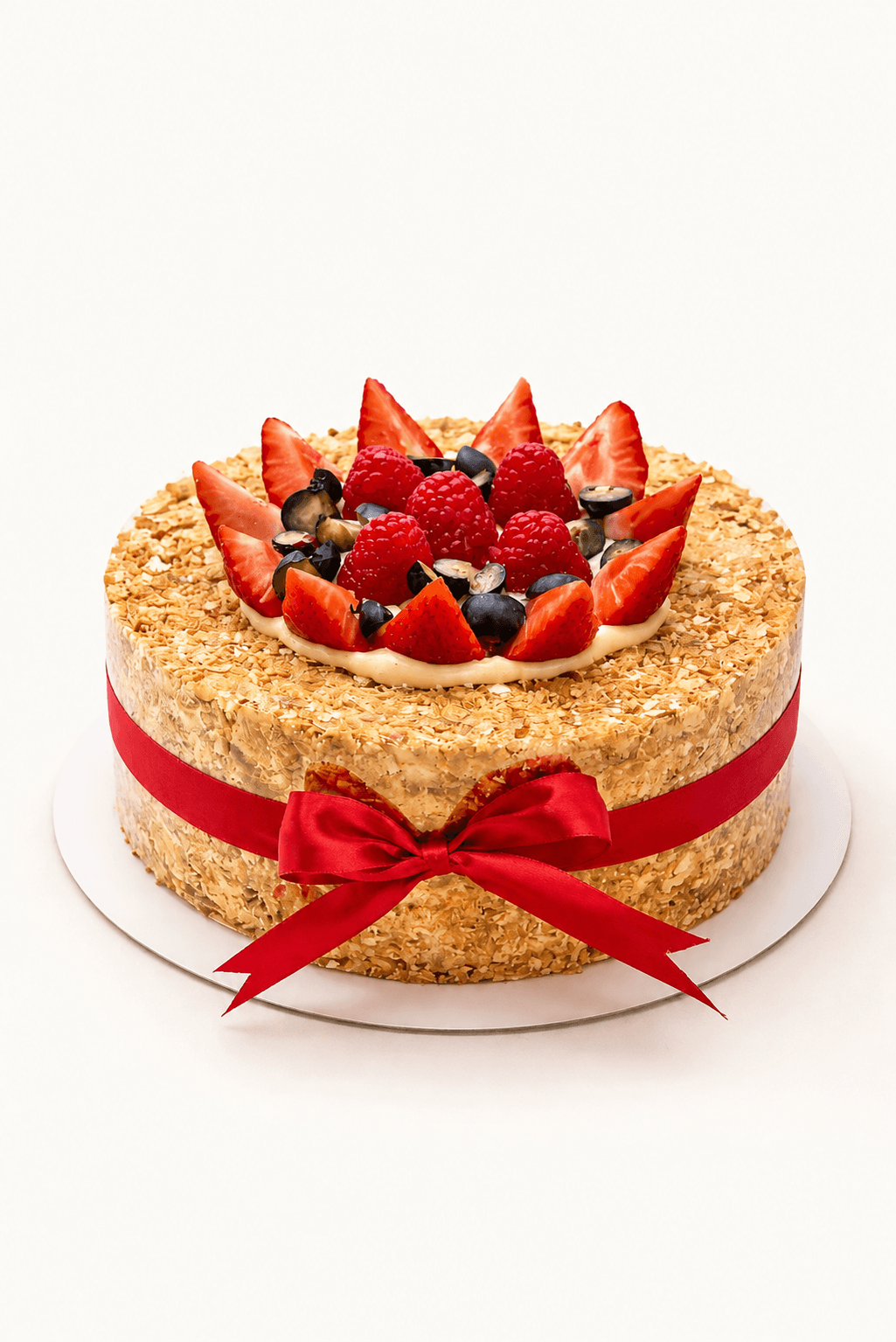
Napoleon is the cake people order when they are testing a bakery. Everyone's grandmother made it, and everyone's grandmother made it slightly differently: more custard, fewer layers, crumbs pressed thickly over the top, or a bare top with a dusting of sugar. It is puff pastry baked in sheets, layered with vanilla custard cream, then rested until the sheets soften and the whole thing slices without shattering.
Ours is Napoleon at 18 cm for £85. It is the most work of anything on the list and the price reflects that. I would not recommend it as a first taste of Eastern European baking to somebody with no reference point, because the pleasure of it is partly the memory. For anyone Russian, Ukrainian or Polish reading this, it is the obvious order, and the honest thing to say is that you will judge it against your own family's version and you may prefer theirs. That is fine. Nobody wins that argument.
Pirozhki, when what you want is lunch
The sweet side of an Eastern European bakery gets the attention. The savoury side is what people actually eat on a Tuesday. Pirozhki are soft baked buns with a filling, sold by the half dozen, eaten warm out of hand, and the fillings are not decorative: cabbage and egg, potato and onion, onion and egg, meat and cabbage, mushroom, liver.
Prices run from £22 for six potato and onion, cabbage and egg, or onion and egg, up to £27 for six of the meat and cabbage, mushroom or liver. All of them need 48 hours. The full range sits under savoury pirozhki. For a first order I would take the cabbage and egg, which is the plainest and the hardest to hide behind, and the mushroom, which is the one non Russian guests reach for twice. Pirozhki are a whole category rather than a single recipe, and the baked kind we make are lighter than the fried version people sometimes remember from markets.
Blueberry streusel buns, the Polish summer bun
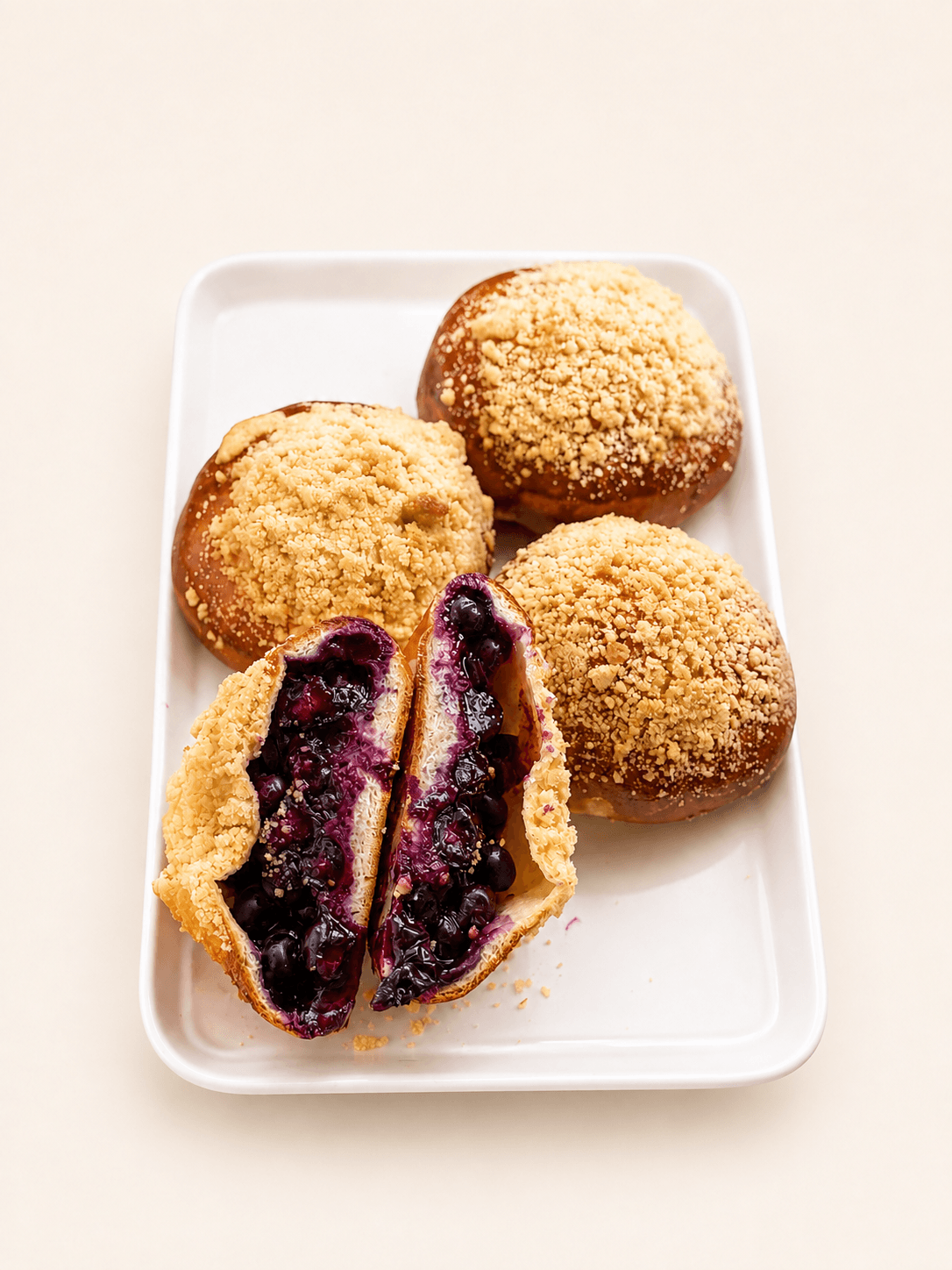
Blueberry streusel buns are £36 for four and need 24 hours, the shortest notice of anything here. Soft enriched dough, a heavy blueberry filling, buttery streusel baked golden on top. In Polish they are jagodzianki, in Russian булочки с черникой и штрейзелем, and if you want the full account of the dough, the kruszonka and the July to August forest season, it is written out in what jagodzianki are.
One difference matters and I would rather state it than let somebody discover it. A Polish jagodzianka is built on czarna jagoda, the wild bilberry, small, dark, sharp, purple all the way through, and it stains the crumb around it. Ours are made with cultivated blueberries, which are larger, sweeter and milder than the forest berry, so the buns are gentler in flavour and the crumb does not go purple in the same way. Poles who grew up picking bilberries in August will notice immediately. Everyone else will get a very good blueberry bun. The same berry, incidentally, grows wild here: bilberry in England, whinberry in Wales, blaeberry in Scotland, ripe on the moors in high summer and long baked into pies in Yorkshire and Derbyshire.
Vatrushki and the tvorog family, for people who like things less sweet
Tvorog is the fresh curd cheese that half of Eastern European baking depends on. It is drier and more sour than ricotta and it is what fills vatrushki, syrniki, sochniki and choux rings. If a customer tells me they find British cakes too sweet, this is the shelf I point at.
Strawberry vatrushki are £32: soft buns with a vanilla tvorog centre and fresh strawberries. For a cheaper way in, syrniki are £15 for six, small tvorog pancakes eaten for breakfast with sour cream or jam, and they are the single most ordinary, most loved thing on the whole site. Neither is a special occasion order. Both are what people from Moscow, Kyiv or Minsk miss most and mention least.
Kyiv cake, for a table that wants something to talk about
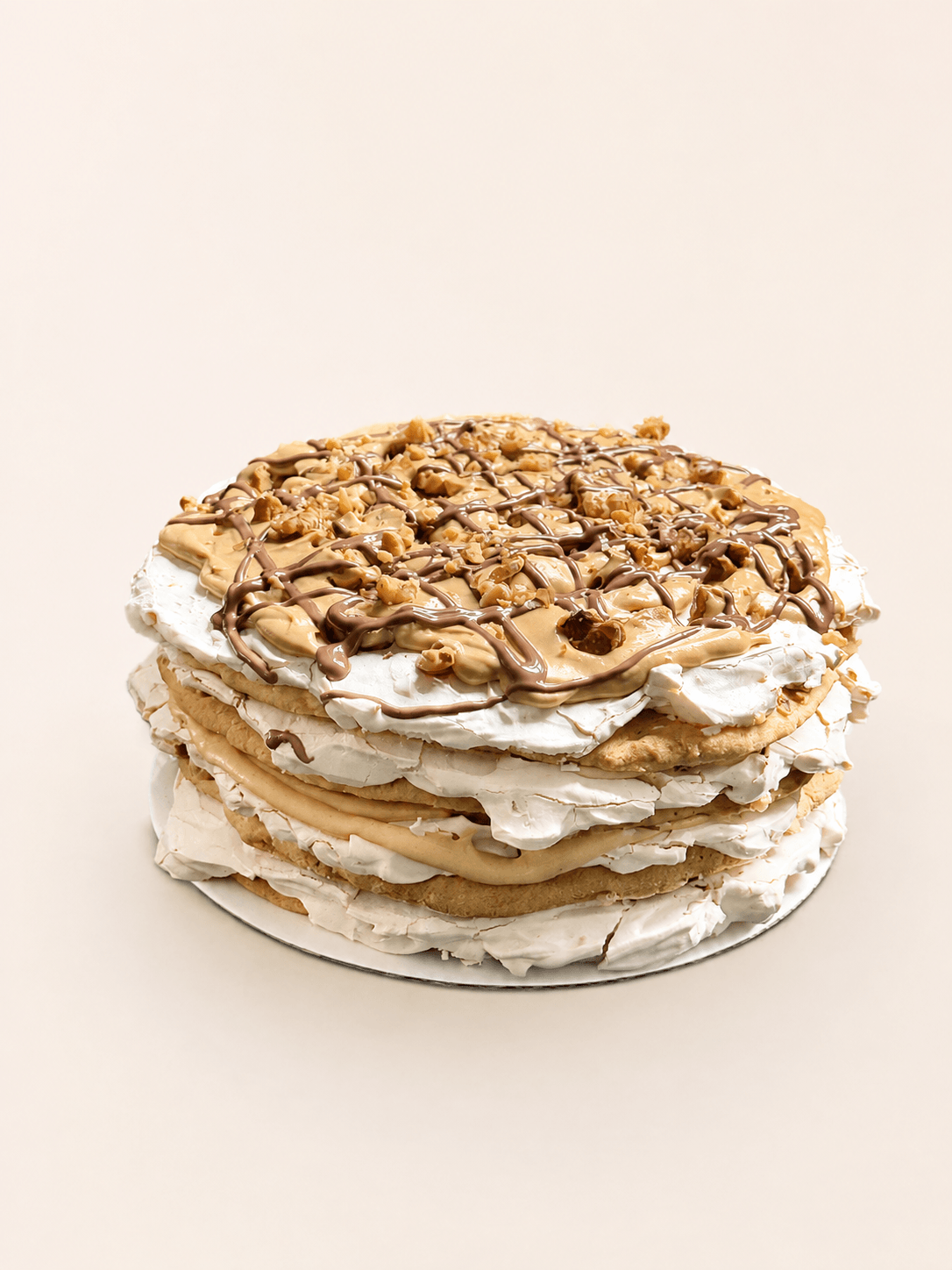
Kyiv cake is £80 at 18 cm: hazelnut meringue layers, buttercream and chocolate. It is crisp where the others are soft, it holds its shape on a plate, and it is naturally light on flour, which makes it useful when somebody at the table is avoiding wheat without needing a formally gluten free cake. For that there is the Esterházy at £75, which is gluten free by construction rather than by substitution.
Kyiv cake is the one guests ask about. It looks like nothing else on a dessert table and the meringue layers make it obvious that somebody spent a day on it.
Where to start, depending on what you already know
If you grew up with this food, order the Napoleon or the medovik first, because you have a standard to measure against and there is no point pretending otherwise. Add six pirozhki. You will know within a day whether this kitchen is worth coming back to.
If you have never eaten any of it, start smaller. Four blueberry streusel buns at £36 with 24 hours' notice is the lowest risk order on the site and arrives ready to eat with coffee. Add the honey cake if there are more than four of you.
If you are ordering for an office or a party, the buns and pirozhki travel and portion better than a cake, and both are sold in fixed boxes so the maths is simple.
Delivery areas and costs are set out at delivery. Bread is separate: sourdough, rye and Japanese milk loaf are baked on Wednesdays and delivered the same afternoon to Virginia Water, Weybridge, Ascot, Sunningdale, Sunninghill, Egham and Englefield Green, on the bread round.
If you are stuck between two things, email info@mikebakes.uk or call +44 7922 122149 with the number of people and the date, and I will tell you which of the two travels better and which one people finish.
Order it for the date you need
Everything here is baked to order for your date.
48 hours notice, 72 for bread. Delivered across London and Surrey.